Showing posts with label Jacqueline Hase. Show all posts

Monday, April 20, 2015

Apparently, the Cambion Can Change

... for the better! 

Overall, I really liked this story. I thought that, unlike some of our previous romances, this one balanced action with the rest of the narrative well. I also liked how even though infidelity is what sets the story in motion, there's very little emphasis on sexual transgression past Sir Gowther's birth. There's little emphasis on romantic relationships at all, which is refreshing - while the maiden is beautiful but mostly mute (which is another discussion for another time), she is not the focus of the story, or Gowther's focus either. They marry in the end once he becomes a better person, no fuss, no drama. While I understand that drama is what makes a romance, I was glad to see a female character who doesn't suffer overmuch. A lot of the action in medieval romances occurs at a woman's expense, like in Emare. I was glad to see that the trend somewhat changed here.

This tale was also sensational, and I am a huge fan of the sensational. I love the supernatural, and the concept of cambions (half-human, half-demon children) is appealing to my love of weirdness and witches and magic and all that fun stuff. I shouldn't have been surprised by the fact that Gowther was a literal hellion, but I was, because I was hoping that he would be his own person and not so... devilish? Murdering people and biting your mother's nipple off is not a great start to life, dude.

   Laverne's Jesus disapproves of your... shenanigans. 

While I liked Sir Gowther's unapologetic murdering (because it was such a non-issue; he just killed people and that was what he did), I have a difficult time really wrapping my head around the fact that, redemption aside, he did kill a lot of people and did a lot of terrible things, and that becoming forgiven doesn't change the fact that those things happened. Just because you're forgiven doesn't mean that everything is fine - the medieval idea of forgiveness and mine are two totally different things, which is sometimes makes things hard in class. 

Even though this is a little paradoxical, I was actually a little sad that Gowther had a literal "come to Jesus" moment. I love monsters, and I love it more when monsters embrace their monstrosity, I'm not quite sure why. 

Sir Gowther, immediately following his... talk... with his mom. 

But really: "oh my god" is a great summary for this tale.

Monday, April 6, 2015

The Classics Never Die

It's been how many thousands of years, and Greek mythology still informs how much of Western culture? It doesn't matter; it's so interesting to see how these legends evolved!

Sir Orfeo is a retelling of the Orpheus legend, which is one of my favorite Greek myths of all time - emphasis on the retelling of the story, because it isn't the same as the original myth. To be fair, ancient Greek myths were so heavily regionalized and re-purposed (depending on who was in charge at the time) that it's hard to find just one to be considered canon, so maybe Sir Orfeo isn't as far off-base as I think it is. Honestly, who knows? 

The first thing that popped into my head about Sir Orfeo is that, aside from the Breton influence there, it almost seems to be a convergence of two myths rather than just Orpheus's tale. The abduction of Herodis into the "underworld" has much more in common with the legend of Persephone and Hades than it does in the so-called "standard" Orpheus myth, where [SPOILER]: Herodis (Eurydice) is killed by a snakebite, and Orfeo/Orpheus descends to rescue her. 


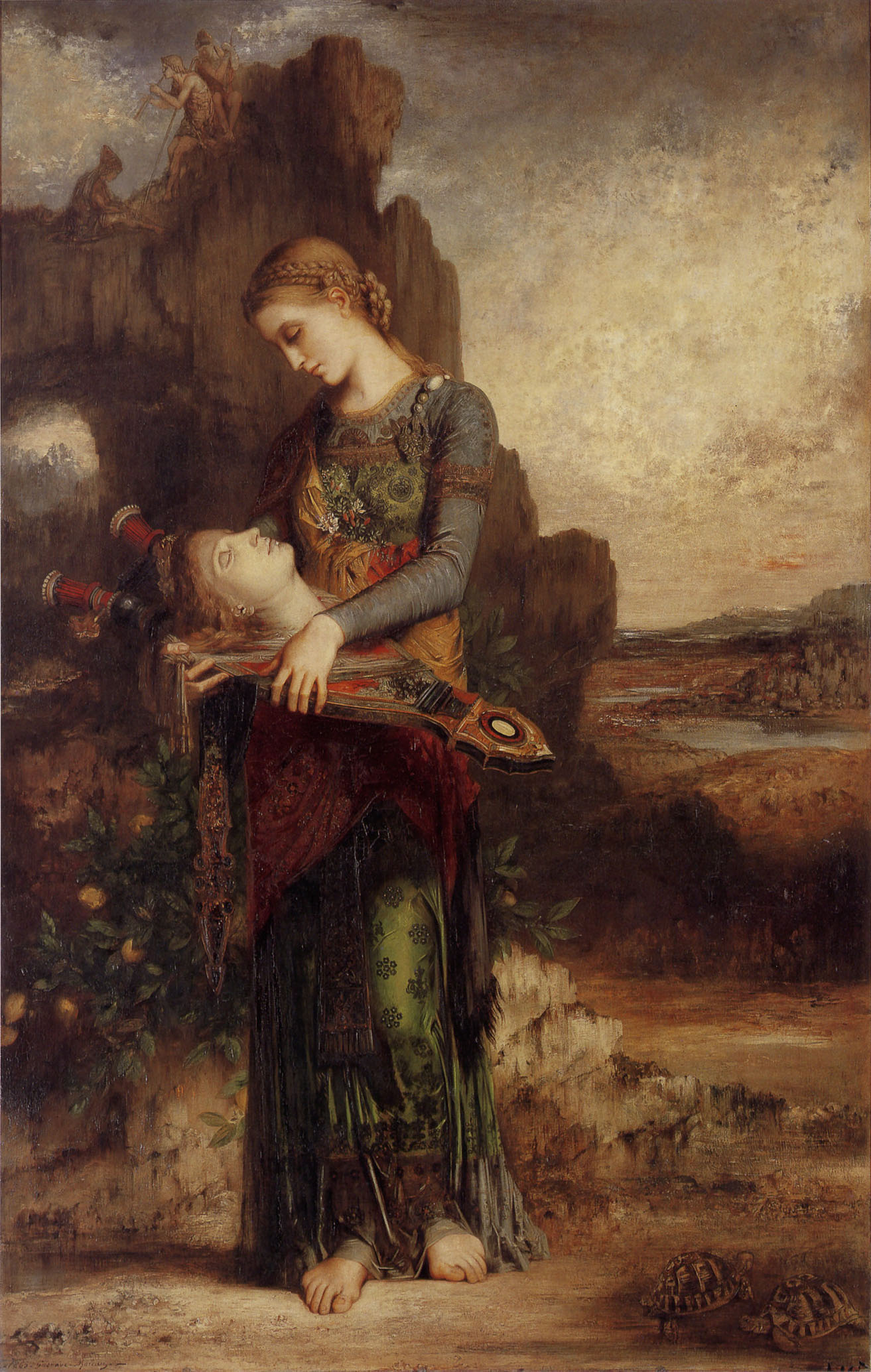
Thracian Girl Carrying the Head of Orpheus on His Lyre, Gustave Moreau, 1865

I thought it was interesting that the story's ending was changed into a happy one. I don't know why the ending was changed - my guess it was an attempt by the author to make the story more accessible to a newer, more modern audience? But several of the stories we've read were incredibly brutal and violent. What makes a husband losing his wife through his lack of willpower/emotional devastation and then being torn apart by drunk Dionysus groupies any different than a head getting chopped off or a poker up the ass? All of those things kind of exist in the same vein. There's no reason the author couldn't make it more like a traditional romance, unrealistic violence and all. 

This story was a change, because there wasn't really any violence or political intrigue. It wasn't quite... boring, but it also wasn't as bombastic as, say, the Knight of the Cart or the Knight's Tale. 

Not present in the story: rippling muscles.
Also not present: pretty much any action at all.

The one thing that irritated me about Sir Orfeo is that there isn't a reason given as to why Herodis is abducted. It just seems like the king of the underworld showed up in a dream and kind of told her he was gonna grab her for no good reason. Am I missing something? 

Overall, I really liked this story, if only because I enjoy the Orpheus legend and all its various forms, even Tennessee Williams' Orpheus Descending which follows the legend but... in a really abstract way? What even happened there? Anyway, Sir Orfeo is an interesting take on a very archetypal myth. 


Monday, March 23, 2015

Kneeghts and Fayerays: Every Middle (English) Man for Themselves

This story was a complete and total whirlwind. I've never read Middle English before, so I decided that it would be best to read the entire thing out loud and get a feel for the words. It is so very, very difficult not to say knight as nite instead of KNEECHT and might as MEECHT, but it was a learning experience, and was actually really enjoyable and hilarious.   


Im heer to ruine alle youre lives. 

That being said, I did like the story overall. I thought there was a bit of a change in the Wife's sermon now that we read it in the original text, that there was more emphasis placed on poverty than what the modern English version had given us. Maybe it's just because it's a different form of English, but I felt there was a lot more emphasis placed on the socioeconomic status of the wife. 

I also felt it was easier to disconnect from the kneecht and his crime, maybe because it takes a little longer to process the words, but...  I didn't see too much emphasis on character? I mean, there are Distinct People here who Do Things, but aside from the fact that the kneecht is a completely shitty person, there's not a lot of who they are. I couldn't really feel much personality from any of them, which is always strange for me in a piece of literature. 

(and now I'm going to forever refer to "knights" as "kneechts" and no one can stop me)

Monday, February 16, 2015

Knights, Dwarfs, and Carts - Oh My!

Okay, first thing I noticed about this story: Chretien de Troyes really likes including dwarfs. I'm not sure what's up with that, but there was a dwarf in Erec and Enide, and now there's one here, and they're both equally nasty and gross. Dwarfs are "ill-born and ill-bred" (pg 174) - I wonder if this has anything to do with re-purposing old Germanic/Celtic pagan legends, but that's something of a long shot. It also doesn't help that whenever I think of these dwarves, I think of the Keebler elves.


I didn't choose the the thug life, the thug life chose me.

 I was a little confused as to why a cart would be a bad thing, because a cart, in my head, was just the same thing as a wagon, even though the text explains it, kind of? It is not a wagon? There seems to be some weird hierarchy of wooden transportation devices, which is confusing? Was it because carts were associated with poop and criminals and shame? 

I would appreciate it if Chretien de Troyes would use more proper names - between "the knight", "the knight", "the knight", and "the other knight", I have no idea who anyone is, unless you are "of the cart" or "Sir Gawain". The entire exchange between the knight of the cart and the knight of the ford (?) reminded me a lot of the thumb-biting exchange in the beginning of Romeo and Juliet, which was hilarious. 


I can tell that the knight of the cart is in love with someone, but who? He's distracted for seemingly no reason and just kind of... mopes... while trying to rescue the queen, who is one of the many young ladies Chretien references??? I admit, this story is rather difficult for me to follow because Chretien likes to jump around a lot and reference people indirectly. I'm still not 100% sure what's going on. 

Monday, February 2, 2015

Cultural Connections

So, this week we're to have read three more lais for class: Equitan, Le Fresne, and Bisclavret. I have to say that I was way more enamored with these stories than I was with Lanval, though that wasn't Lanval's fault - I just like adultery, near-infanticide, and werewolves a bit more than I like mopey knights and possibly-fae ladies romancing them and saving the day (you go, fairy lady). I like drama and intrigue, and there was a lot of that in the readings for this week. 

Out of all of these, I was most surprised by Equitan. I was expecting them to get their comeuppance somehow, because they both cheated and that violates the rules, but getting boiled alive was a little bit extreme I thought. I did do an image search to see if there were any period cartoons to describe this, as it was a real way that medieval prisoners were tortured, and oh! fun fact: Google actually auto-filled "medieval boiling torture" as a search parameter. I'm slightly disturbed. But what I thought was interesting was that this search directed me to this website (warning: if you're easily triggered by violence and/or torture devices, I would stay off this page), which stated that "torture was used almost exclusively for the crime of treason" - if you consider cheating on your spouse, who you married before the eyes of God and the government and the universe, a form of treason, then was their punishment deserved? 

(Obviously, cheating is wrong unless you're both into that, but death is a little over-the-top. You shouldn't let your marital problems come to a boiling point.) 


Knight on the left is like, "you're so going to hell, dude." 

Le Fresne I found to be formulaic, but happy - I was actually more interested in the trope of the separated twins and the foundling child than I was in the actual plot of the story, because this is an archetype that's seen throughout the world. The fact that nobody died is a plus too. I was actually struck by the similarity between Le Fresne and a tale from the Arabian Nights, whose specific title I don't actually know, but is called The Story of the Speaking Bird at this website. In this tale, two sisters are jealous of the other, who is married to the Sultan. They steal each of her three children and replace it with an animal as soon as it's born, and tell the Sultan his wife has delivered a monster. The three children are raised happily by a gardener, ignorant of their heritage. Anyway, I won't spoil it for you, but it was just interesting to note. 


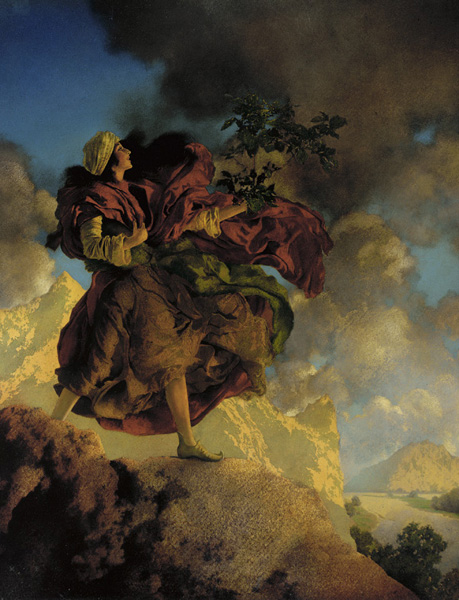
Princess Parizade Bringing Home the Singing Tree, Maxfield Parrish, 1906

And lastly, there is Bisclavret. I liked Bisclavret, not only because I like werewolves, but because the lai was just... funny-ish? It was humorous, in a strange way, because Bisclavret was a different kind of werewolf than we expected. A werewolf here is more akin to "a man wearing a wolf's skin" than a separate supernatural species, kind of like Viking berserkers, who were called that because they wore bear pelts (the ones who wore wolf pelts were called ulfhednar), and changed their mentality but not their form. Here, like in Equitan, there is a form of marital treason at the hands of the wife - a story where Marie is not particularly kind to her own gender, which is interesting to note because she can sometimes vacillate between extremes when it comes to perception of women. 

And to wrap this up, have a lyric video of Arthurian-mythological song about Mordred, and Morgan le Fay. Some of you might have heard it already but... (by the way, this artist specializes in Celtic music, and she is amazing.)


Heather Dale, "Mordred's Lullaby", Avalon or The Trial of Lancelot 


Works Cited: 
  • McDonald, James. "Medieval Torture." Medieval Warfare. Castles and Manor Houses Inc, 11 Apr. 2012. Web. 02 Feb. 2015. 
  • Wikipedia - "Berserker", http://en.wikipedia.org/wiki/Berserker
  • Wikipedia - http://en.wikipedia.org/wiki/File:Princess_Parizade_Bringing_Home_the_Singing_Tree.jpg
  • "THE STORY OF THE SPEAKING BIRD." More Fairy Tales from the Arabian Nights. N.p., n.d. Web. 03 Feb. 2015.