Showing posts with label Sir Orfeo. Show all posts

Tuesday, April 7, 2015

A Love Story for the Ages...


So I don’t know what everyone else is thinking about this story, but I actually really liked it, and I was totally surprised that I did. Middle English can be so hard to read, let alone understand and yet I feel I have enough of it under my belt to not be intimidated by it anymore. I had never heard the story about Orpheus before, so I had to read the link that Dr. MB suggested that we read beforehand, but even so I really ended up liking the story. I think, for the first time, I got the sense that we were reading about a couple that truly cared about each other, to the point that they were both incredibly distraught when they had to separate for years because of the faery king.
 
 
Although the story itself is odd because of its mystical element, I connected with it because it reminded me of a real life situation in which a couple that truly loves each other, may be separated for reasons beyond their control. Maybe it is family tensions, maybe it is any other obscure situation that I can’t really explain right now in a blog post but I am sure some of you get what I am trying to say. I mean…do I think the king should have forsaken his entire kingdom? No probably not, but is I romantic in a way? Yeah it kind of is.
 
 
His love for her is so encompassing that he cannot imagine ruling without her. “Al his kingdom he forsoke; Bot a sclavinon him he toke.” (227-228) Also…I am a bit of a sucker for happy endings. I like that neither one of these main characters plays hard to get, and that once they see each other they are genuinely ecstatic to see each other (I am still bitter about the Knight and the Cart). Speaking from a perspective of a person who has grown up on Disney fairy tales, I felt that this story was a classic hero, villain, damsel in distress gets saved by the hero kind of story, and I love that. The only issue a small part of me has with this story is the feminist side that is annoyed that the woman could not save herself, but that simply speaks to the time period in which this story was written.

Monday, April 6, 2015

Repetition


Friends, comrades, fellow students... I think we can all agree that after taking this class, we have a very good, well thought out idea on love. From the first piece we read (Courtly Love from Andres Capellanus) to the most recent piece (Sir Orfeo), we can conclude that the middle ages were a time period full of horny, love-crazy bastards.
Image result for greek love

However, what I have been noticing in these past two stories, is that the characters and settings are Greek-based. Now, I may be the only person who thinks of this, but love is similar in every time period... except the Greeks and Romans. Those were some crazy people lol (insert emoji here)

Now to the story! I thought of this as a repetitive piece, like the other copious amount of stories we have read. Women gets kidnapped by stranger, guy gets pissed, epic adventure, she gets saved by guy, and they live happily ever after. Half way through, I could come up with the ending in my head, and I was right. As the famous rapper OG Maco would say, "Bitch, you guessed it Hwah, you was right."
What pissed me off the most, and I don't know why, were the fairies. I mean C'MON Man! You would think fairies would be these nice, mystical people who spread happiness with a flick and swish of a wand (Hah! Harry Potter reference). But NOOOOOOOOOOOO!!!!!!!!!! These little turds end up kidnapping the queen and many others, and hide them in a castle. When Sir Orfeo is granted access, I was thinking a huge fight was going to happen, not him playing his harp to the fairy king. The more I think about it, however, Sir Orfeo has the talent. As a child, he was given the gift of music, so he can play the hell out of a harp. We could call Sir Orfeo the Eric Clapton of harps.

Image result for eric clapton


But, again, after finishing this, I wasn't really pleased. The stories are getting so similar, that I really haven't been hooked by any plot line. If this was Metacritic, I would give this a solid 47 for not being original.

Why the happily ever after?

To start off, I found this story quite boring. There wasn't any excitement or major twist and turns. It was just a disappointment for me. Growing up, Greek mythology was one of my favorite subjects to learn. I reread the story of Orpheus and Eurydice before I read this poem, and it’s just exactly how I remembered it. Then I read the poem and was pretty much saying what the hell is this…


The way this poem started, I could have recited it myself once I got to the part where Herodis went missing. She literally disappeared in the air, and was just gone. Once that happened, I knew exactly what was going to come next. This story was like a repeat for many of the other stories we have read. Queen goes missing, King goes into disguise and follows.

What also confused me was the description about the other girls in the castle. Some stood without heads, some without arms, some had wounds, giving birth?! Like what, its like zombie land or something. Everyone is just crazy looking.


 BUT! The one thing that surprised me in this poem was the fact that there was no violence or gory what so ever, which should have been included because in the real story, Orpheus gets ripped apart. Secondly, the ending. THE ENDING! A happy ending? No way. The whole part where Orfeo “pretended” to just be a minstrel to see if his steward was still loyal made it seem like a whole new story was about to begin. I didn't like that at all. The author really took a stab at the ending by making it different.

Next, why the emphasis on the “impe-tree?” I really didn't understand how the importance of this tree made it resemble the true story they are trying to convey. Herodis was identified under this “impe-tree” twice in the story. Why exactly was this important? In the real story, Eurydice died because of a snakebite, nowhere in the story does she actually come back to life and live. In Sir Orfeo, Herodis doesn't die at all! It was a complete mess. I mean, I really enjoyed how Orfeo sacrificed his royalty and honor to go save his wife from who knows what. Isn't that cute??

The one thing that I really liked about this poem was the emphasis on how much going away for ten years really changed a man. Orfeo literally went from riches to rags. Weird huh? The author described Orfeo only having a “pilgrim’s cloak, neither a tunic or a hat or shirt or anything like that” (228-230). Also, at the end of the story, he is described with having, “How long the hair is on his head! Look how his beard hangs down to his knee! He is as wrinkled as a tree!” (508-510). You can just imagine the way he looks by this description. It really shows how long Orfeo has been gone that not even his own people can recognize him.

The Classics Never Die

It's been how many thousands of years, and Greek mythology still informs how much of Western culture? It doesn't matter; it's so interesting to see how these legends evolved!

Sir Orfeo is a retelling of the Orpheus legend, which is one of my favorite Greek myths of all time - emphasis on the retelling of the story, because it isn't the same as the original myth. To be fair, ancient Greek myths were so heavily regionalized and re-purposed (depending on who was in charge at the time) that it's hard to find just one to be considered canon, so maybe Sir Orfeo isn't as far off-base as I think it is. Honestly, who knows? 

The first thing that popped into my head about Sir Orfeo is that, aside from the Breton influence there, it almost seems to be a convergence of two myths rather than just Orpheus's tale. The abduction of Herodis into the "underworld" has much more in common with the legend of Persephone and Hades than it does in the so-called "standard" Orpheus myth, where [SPOILER]: Herodis (Eurydice) is killed by a snakebite, and Orfeo/Orpheus descends to rescue her. 


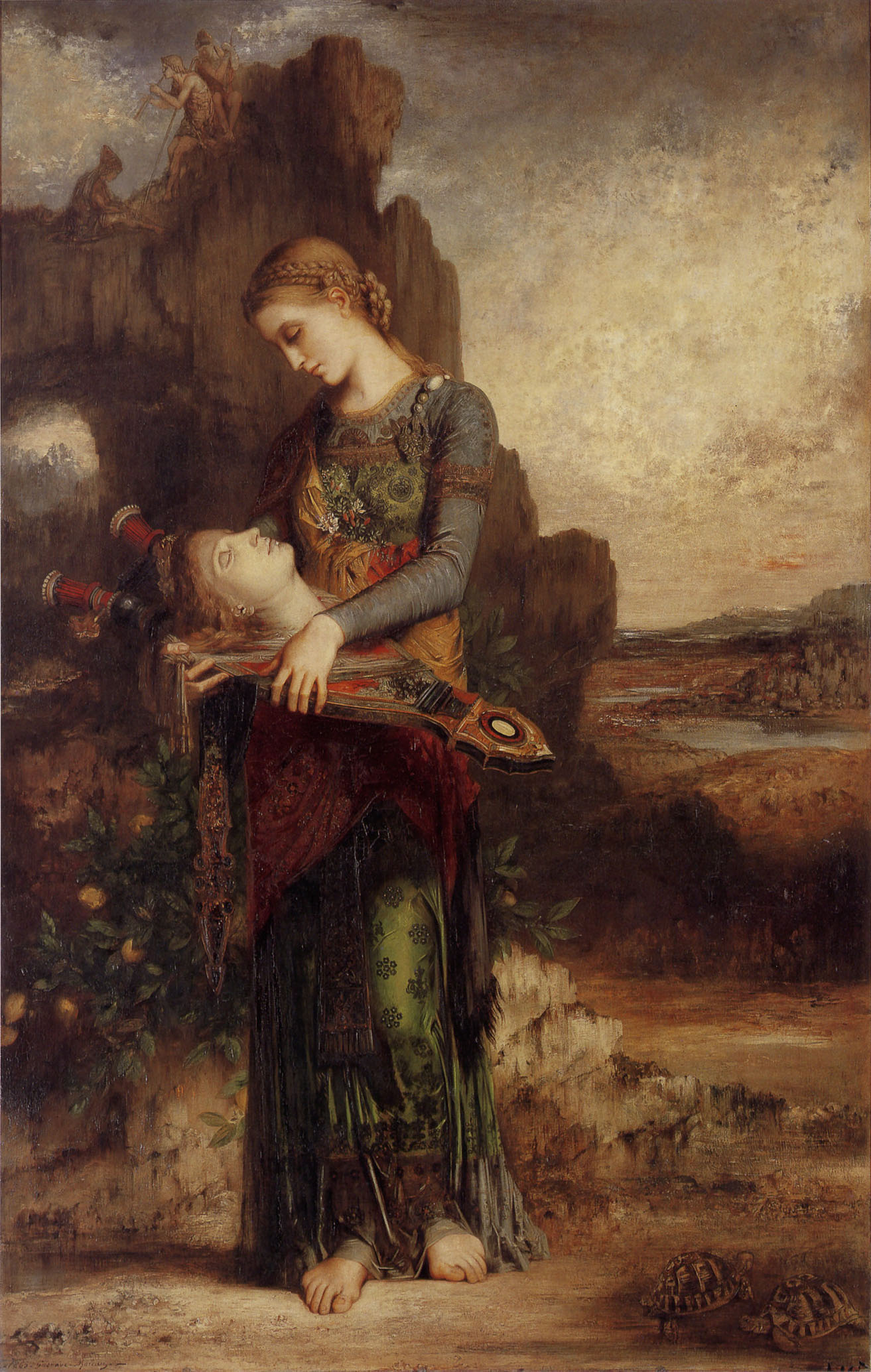
Thracian Girl Carrying the Head of Orpheus on His Lyre, Gustave Moreau, 1865

I thought it was interesting that the story's ending was changed into a happy one. I don't know why the ending was changed - my guess it was an attempt by the author to make the story more accessible to a newer, more modern audience? But several of the stories we've read were incredibly brutal and violent. What makes a husband losing his wife through his lack of willpower/emotional devastation and then being torn apart by drunk Dionysus groupies any different than a head getting chopped off or a poker up the ass? All of those things kind of exist in the same vein. There's no reason the author couldn't make it more like a traditional romance, unrealistic violence and all. 

This story was a change, because there wasn't really any violence or political intrigue. It wasn't quite... boring, but it also wasn't as bombastic as, say, the Knight of the Cart or the Knight's Tale. 

Not present in the story: rippling muscles.
Also not present: pretty much any action at all.

The one thing that irritated me about Sir Orfeo is that there isn't a reason given as to why Herodis is abducted. It just seems like the king of the underworld showed up in a dream and kind of told her he was gonna grab her for no good reason. Am I missing something? 

Overall, I really liked this story, if only because I enjoy the Orpheus legend and all its various forms, even Tennessee Williams' Orpheus Descending which follows the legend but... in a really abstract way? What even happened there? Anyway, Sir Orfeo is an interesting take on a very archetypal myth.