Showing posts with label Team Percival. Show all posts

Monday, April 20, 2015

Gowther? I Hardly Know Her!

Honestly, this post is almost embarrassing to write. It certainly will be a significant deviation from my usual analysis - while I generally can't be swayed from Marxism, feminism, and/or post-structuralism (or similar analysis which posits itself within the radical left of the political spectrum), when reading, Sir Gowther I found my blog post practically writing itself through the thought of one of philosophy, psychology and literary theory's most hated and debated:


http://cdn1.bigcommerce.com/server4100/deb25/products/150/images/423/Pink_Freud_sigmund_Freud_T_Shirt__16201.1350447552.1280.1280.jpg
Get Siggy with it
The titular knight's character progression falls almost uncannily into the Freudian five stages of psychosexual development. These stages deal with the sexual impulses of the child, and how they relate to the id, ego, and superego in determining his behavior through his development. The first stage is the oral stage which deals primarily with the act of breast feeding. As young Gowther does it, he displays demonic intensity which causes several deaths. This serves to establish his exceptionally strong libido from the beginning of the text, and a major theme ultimately his his superego adopting religious moralism in an attempt to tame this impulse of the id.
The second stage, the anal stage, is deemed unimportant and skipped as the narrative advances from him at age 1 to age 15. The third stage is the phallic stage. 
http://upload.wikimedia.org/wikipedia/en/archive/c/c4/20140729091034!Sephiroth.png
http://tvtropes.org/pmwiki/pmwiki.php/Main/BFS
Here, Gowther expresses his libido through his phallic falchion, which becomes symbolic of his ego, as it was a weapon "he could hold but no one else could bear." (140-141). His excessive use of it for violence expresses that his ego is presently dominated by the id, rather than having balance between the id and the superego. The primary motivation in this stage is the Oedipus complex, to kill his father and gain sexual possession of his mother. While this is not explicitly acted on, it is implicit in the duke dying, essentially from shame for his son's actions (154). The Oedipal element is also present in Gowther's interrogation of his mother to find his father's true identity; he is beset on killing the correct target of his psychosexual envy. The fact that he has failed to do so causes him to fixate in the phallic stage, and much of his motivation in the remainder of the story, even as he progresses through the remaining stages, is brought by his desire to absolve himself of the sins of his heritage, and in that way "defeat" his true father.
The fourth stage is the latency stage. In this stage, the sexual desires are inactive. This is where Gowther travels to Rome. This brings much of the development of his superego, of which the Pope is symbolic. Through the humiliation of having to eat the leftovers of dogs, he is immasculated and cut off from his libido.
The fifth and final stage is the genital stage. This is the stage at which Gowther has matured as an adult with healthy non-incestuous sexual drive. He demonstrates this as he fights as a knight for the emperor - he has learned, through the temperament of his religious superego, to use his phallic falchion towards good Christian causes and to protect his sexual interest (the Emperor's daughter). The daughter's salvation from death and the Pope's redeeming affirmation: "Of God you are the child. No longer fear the warlock wild, for vanquished now is he." (673-675) are final proof that Gowther, through the redemption of Christian superego, has "vanquished" his real father and can finally escape his phallic fixation and live as a well-adjusted adult.
http://cdndata.bigfooty.com/2014/04/52251_51936b35f355b02c83f037fa44a05af1.jpg

This analysis is silly, Freud is silly and I hope to never again find myself writing it.

The devil prays to Christ?

I loved this story! By far, one of the best stories we've read so far. When I first heard this story was about the son of the devil, I was like woah? I was really shocked as to how the story turned out. Their definitely is a constant theme in the recent stories we have been reading. Forgiveness is key. But why not? Forgiveness isn't a bad thing, is it?

Who doesn't love a little peace?
I really loved how Sir Gowther redeemed himself to becoming a “good” person. The beginning of the story was definitely clear that he was the son of the devil. I understand he did things that were gory and disgusting, but he made a turnaround for the best. I also really liked how Sir Gowther didn't just get handed forgiveness. He worked his ass off and became a person he wasn't. I mean, they made him eat food from a dog’s mouth! Come on, give the man some credit. But who doesn't like bad boys?

This story was probably one of my favorite stories, aside from Emare. To me, reading this story brings me back to the old saying, “there is light at the end of the tunnel.”  I feel like we should always give people a chance, no matter the damage they have done. As for Sir Gowther, he really made a turn around to becoming someone new. It happens in our everyday lives. I understand that forgiveness may be a hard factor for some people. Just because we forgive someone, does that make EVERYTHING “okay?” Damage was done, but that doesn't necessarily mean everything is alright. But there are always second chances and forgiveness that we can turn to.


The challenge that the Pope gave Sir Gowther is out of his league. Giving up his falchion and refusing him to speak?? That’s kind of harsh. The falchion is what brought him to where he ended up in the ending. By letting Sir Gowther use his falchion while fighting off the other knights made him noticeable. It was his skill and hardship that he displayed that allowed God to forgive him of all his sins. Ultimately, since this a romance course, he led him to a dumb, but beautiful maiden!  It led to a happen ending, with marriage. Even though the emperor’s daughter was dumb and mute, it worked out well in the end. She didn't suffer as much like the other women in other stories we have read. This was a little cute happy ending that Sir Gowther ultimately deserved.

Wednesday, April 8, 2015

Chaucer: Still a Misogynist, but Funny this Time

The Miller's Tale was a hilarious read, one which I thoroughly enjoyed. I take a certain amount of pleasure out of the humiliation of men, particularly those insistent on pursuing unrequited romantic or sexual interest, and Absolon's scatological demise (when "Nicholas anon let fle a fart" (3806)) was particularly amusing to my taste.
Butts are indeed the highest form of comedy.


However, to take a darker tone, there was a particular note that troubled me, and one that seems to form somewhat of a pattern in Chaucer's work: the vindication of the rapist. I discussed this at some length in a previous blog post, discussing the Wife of Bath's Tale. In that post, I used the protagonist's ultimate escape from any consequences (and essentially, his benefit) from having committed the violent crime of rape that served as the main conflict and driving plot force of the tale as part of my argument that the text fails to stand up to a critical feminist analysis.

While not involving the same (assumed) intensity of the rape in the Wife's Tale, the Miller's Tale is also heavily driven by a man committing an act of sexual assault, when Nicholas grabbed Alisoun "by the queynte," (3276) without consent and to her protestations. Again, not only does he not receive any sort of punishment for doing so (except arguably the hot poker from Absolon), but he is rewarded with fulfillment of his sexual aims. This pattern is alarming and certainly indicative of underlying misogyny in Chaucer, even as he attempts to subvert tropes rooted in it.
Get it?? ...because it's ROOTED in it??? ...no? anyone?... I'll show myself out.


The obvious counter-argument here is that this tale is not to be taken literally or seriously, as it's parody. This calls to my mind an infamous interview in which Slovenian cultural critic Slavoj Zizek is praising the film Kung Fu Panda.


Zizek interprets Kung Fu Panda as being effective because it parodies an ideology while simultaneously endorsing it wholeheartedly. I believe the Miller's Tale is a Kung Fu Panda - while parodying misogynist tropes of the era, it also endorses and rewards misogynist exertion of power. This is doubly effective - those who support this subjugation will enjoy its endorsement, and those who oppose it will enjoy the subversion. Both will implicitly support the text's patriarchal ideology.

Thinking on a larger scale, I find intrigue in Chaucer's use of the Kung Fu Panda ideological tactic simply because it's one I most strongly associate with the liberalism of the Enlightenment to the present, as it is a tool often used to obscure the ideological nature of content that supports hegemony within this framework. I don't know enough about the history of the Kung Fu Panda to evidence this, but I suspect that, similarly to things I discussed in my previous blog post, Chaucer is anticipating ideological components of liberalism and capitalism in a way that leaves him seeming, ironically, very forward-thinking (in the sense of dialectical progression of history) despite his misogynist tendencies.

Monday, April 6, 2015

Why the happily ever after?

To start off, I found this story quite boring. There wasn't any excitement or major twist and turns. It was just a disappointment for me. Growing up, Greek mythology was one of my favorite subjects to learn. I reread the story of Orpheus and Eurydice before I read this poem, and it’s just exactly how I remembered it. Then I read the poem and was pretty much saying what the hell is this…


The way this poem started, I could have recited it myself once I got to the part where Herodis went missing. She literally disappeared in the air, and was just gone. Once that happened, I knew exactly what was going to come next. This story was like a repeat for many of the other stories we have read. Queen goes missing, King goes into disguise and follows.

What also confused me was the description about the other girls in the castle. Some stood without heads, some without arms, some had wounds, giving birth?! Like what, its like zombie land or something. Everyone is just crazy looking.


 BUT! The one thing that surprised me in this poem was the fact that there was no violence or gory what so ever, which should have been included because in the real story, Orpheus gets ripped apart. Secondly, the ending. THE ENDING! A happy ending? No way. The whole part where Orfeo “pretended” to just be a minstrel to see if his steward was still loyal made it seem like a whole new story was about to begin. I didn't like that at all. The author really took a stab at the ending by making it different.

Next, why the emphasis on the “impe-tree?” I really didn't understand how the importance of this tree made it resemble the true story they are trying to convey. Herodis was identified under this “impe-tree” twice in the story. Why exactly was this important? In the real story, Eurydice died because of a snakebite, nowhere in the story does she actually come back to life and live. In Sir Orfeo, Herodis doesn't die at all! It was a complete mess. I mean, I really enjoyed how Orfeo sacrificed his royalty and honor to go save his wife from who knows what. Isn't that cute??

The one thing that I really liked about this poem was the emphasis on how much going away for ten years really changed a man. Orfeo literally went from riches to rags. Weird huh? The author described Orfeo only having a “pilgrim’s cloak, neither a tunic or a hat or shirt or anything like that” (228-230). Also, at the end of the story, he is described with having, “How long the hair is on his head! Look how his beard hangs down to his knee! He is as wrinkled as a tree!” (508-510). You can just imagine the way he looks by this description. It really shows how long Orfeo has been gone that not even his own people can recognize him.

Wednesday, March 25, 2015

Chaucer's Feminism Fails, Falters, Falls Flat

As I initially read the Wife of Bath's Tale, I found myself pretty pleasantly surprised with its ideological content. The moral of the story seemed to have a little more depth of social analysis than just "respect women," as seems to be the case in a good many romances. Indeed, the protagonist ultimately learns to give women agency and authority over their own lives and decisions. Given the pervasive conceptualization of the medieval as being more intensely patriarchal than modern society, I was shocked, as Chaucer's ethics seemed in line with the Feminist movements of the 20th and 21st centuries. However, I ultimately found his feminism fell a little flat.
http://i.imgur.com/DHgbhgv.jpg


The language used at the story's conclusion is telling: the knight's bride asks "Thanne have I gete of yow maistrye...Sin I may chese and governe as me lest?" To which he replies "Ye, certes, wyf." (1236-1238) This attempts to serve as the "empowering" high point of the story; the woman establishes agency over herself and the knight learns to respect it. The contradiction lies in the action itself occurring in the lines - she's asking for permission. This act contradicts Chaucer's thesis: her asking permission shows an utter lack of power, as it implies the ability of the knight to say no - to deny her agency. Furthermore, it implies infantilization of the woman, as needing a guiding (masculine) authority over her life. Agency that requires permission is false agency, and Chaucer disguises this under the guise of granting her autonomy.

The knight thusly becomes the primary patriarch in the tale. The driving force of the narrative is his rape of a young maiden, an act which is presently and historically a very gendered crime, and an exertion and demonstration of power. The irony in this is that Chaucer, in his supposed feminism, never actually punishes the knight for his act. In fact, he ultimately ends up with a beautiful and loyal wife - he's ultimately better off than he began for having committed the act. The maiden is misogynistically thrust aside of the narrative. Ultimately, the only purpose of her being victim to such a horrible, traumatic experience is to help the knight learn to be a better person, which is unjustified - the good and bad are hardly equal here.

http://i.imgur.com/lSdxAlb.png?1

The primary woman of the story ends up serving a similar narrative purpose. She does it in such a severe way to foreshadow a modern literary trope - the Manic Pixie Dream Girl. This is a woman, often described as "quirky" or something similar, whose own motives end up being secondary to her helping a male protagonist become a better person - see: every John Green novel. Here, the "Pixie" aspect of the trope is taken literally: she is implied to be a fairy (Osborn, f.n. 18). This further reinforces her lack of agency by stripping her of humanity.

Ultimately, Chaucer serves an interesting role in that his proto-Feminist thought, while almost entirely upholding patriarchal structures, predicts several common tropes of modern liberal feminism - much of which didn't crop up until the revolutionary shift from feudalism to liberalism and capitalism was in full swing. I'll close with a quote, from someone I'm sure you're tired of hearing about:
Michel Fouc-oh, no, not again.

"Power is exercised rather than possessed; it is not the 'privilege', acquired or preserved, of the dominant class, but the overall effect of its strategic positions." (Discipline and Punish 26) Chaucer's downfall is the downfall of much of feminism - he fails to recognize that it's not enough for those in power to claim respect for the marginalized, because it does not change the effect of their position in structures of power or mystically grant 'agency' to the oppressed.

Monday, March 23, 2015

How do you say “The Wife of Bath’s Tale” in Middle English?

First off, why the Middle English? I mean come on! It was such a pain; I literally had to go back and forth between the two books just to make sure I understood everything…I know I know. I’m going to have to get used to it anyways. Interestingly enough, I tried to make the accent and sound like Dr. MB when she reading this…it didn't work out.

Now all that’s aside, onto the story. I actually enjoyed this story. I thought I could have referenced what I was reading to myself. Not the rape part! But about how much power the women held. First things first, why the rape? Knights are suppose to be honorable and loyal, not rapist. Out of all the acts he could have done, he rapes a random maiden that just so happen to be walking past him? This part of the story is what helps trigger the power of women.

So now, about his savor. Did you ever wonder why King Arthur willingly gave the queen the power to decide on what to do with this knight? This was pretty confusing and a turning point for me. The queen was nice enough to give the knight a second chance. All the women in the court, the queen included, wanted to give him another chance before he killed…but why? It was confusing to me why the queen would even want to spare his life in the first place. But! This is where the knight started to lose his power. He knew that he committed a crime, and in order to gain his position back, he must follow orders from a WOMEN. I loved this. She gave him a time limit that he must fulfill, and boy did he make sure he got back in time to give a proper answer.


This whole thing about him learning a lesson, I believe that he did. As a knight, he did keep his word with the old women. Even though he was stunned by her request, he had no choice but to marry her. He really looked down upon her because she was old and ugly, but was that really the case? The old woman goes on and on about the choices she offers her husband. I wish she had turned pretty and treated him differently just for him to get a taste of his own medicine! In the end, he was the one willingly giving up his power to his wife to make the decision for the marriage. He knew that by doing so, it is her that help saved his life. Isn't it ironic that he told the queen that what women desire the most is sovereignty and control over their husbands? Well! In this case, he fell right into it.

Ugly ducklings need love too!

Kneeghts and Fayerays: Every Middle (English) Man for Themselves

This story was a complete and total whirlwind. I've never read Middle English before, so I decided that it would be best to read the entire thing out loud and get a feel for the words. It is so very, very difficult not to say knight as nite instead of KNEECHT and might as MEECHT, but it was a learning experience, and was actually really enjoyable and hilarious.   


Im heer to ruine alle youre lives. 

That being said, I did like the story overall. I thought there was a bit of a change in the Wife's sermon now that we read it in the original text, that there was more emphasis placed on poverty than what the modern English version had given us. Maybe it's just because it's a different form of English, but I felt there was a lot more emphasis placed on the socioeconomic status of the wife. 

I also felt it was easier to disconnect from the kneecht and his crime, maybe because it takes a little longer to process the words, but...  I didn't see too much emphasis on character? I mean, there are Distinct People here who Do Things, but aside from the fact that the kneecht is a completely shitty person, there's not a lot of who they are. I couldn't really feel much personality from any of them, which is always strange for me in a piece of literature. 

(and now I'm going to forever refer to "knights" as "kneechts" and no one can stop me)

Thursday, February 19, 2015

Chrétien de Tr-Oh, yes! & Michel Fouc-Oh, no!

“My most recent reading for fun was the first twenty pages of Discipline and Punish by Michel Foucault, after which I gave up.” - Me, on the first day of class.

This class is taking on a strange cyclical nature for me - upon reading “The Knight of the Cart” I was instantly reminded of what little Foucault I had read. What served as a point of interest to me in particular was the punishment itself - the titular cart - which serves a peculiar analytical position when studied through the lens of Foucault’s explanation of history.

Strap yourselves in, this is gonna be dense.

Discipline and Punish studies the historical shift between feudal penal structures (which it argues to be public and focused on the body) and later capitalistic ones (which it argues to be more private and focused on the “soul”). The punishment of the cart was perplexing to me because it seemed to contradict Foucault’s thesis - while, like Foucault predicts, it was very public, its description in the text seems to indicate a greater focus on the soul, saying “Thus he [the condemned] had lost all honor.” With further thought, I realized something crucial about feudal society, which I believe is key to understanding several of the texts we’ve read thus far: the body and soul were not considered separate ontological entities, as we know them today, at the time. This punishment of the “soul” (through the emotion of shame) here has direct consequences, not just spiritually, but materially, through the system of honor in place at the time. ChrĂ©tien alludes to this: “From then on all courts refused him hearing”. The significance is difficult to understand through our modern capitalist lens, but at the time, this was a very severe material penalty, that had intense physical consequences to the body of the condemned - he would likely be doomed to a life of poverty and solitude, potentially ending in starvation or similar death. For the knight, labor in service of a court was the only option - its denial would lead to death. The punishment of the “soul” here is not coherently differentiable from the material punishment of the body.

Phew!

So ultimately, this long-winded mess has led to the conclusion that medieval ontologies lacked the distinction between body and soul as separate entities that modern constructions have. I am positive that this can be applied to other texts that we’ve read as an interesting perspective and mode of analysis. I, however, will draw upon my roots as a math major: “This is left as an exercise to the reader.”

Monday, February 16, 2015

Knights, Dwarfs, and Carts - Oh My!

Okay, first thing I noticed about this story: Chretien de Troyes really likes including dwarfs. I'm not sure what's up with that, but there was a dwarf in Erec and Enide, and now there's one here, and they're both equally nasty and gross. Dwarfs are "ill-born and ill-bred" (pg 174) - I wonder if this has anything to do with re-purposing old Germanic/Celtic pagan legends, but that's something of a long shot. It also doesn't help that whenever I think of these dwarves, I think of the Keebler elves.


I didn't choose the the thug life, the thug life chose me.

 I was a little confused as to why a cart would be a bad thing, because a cart, in my head, was just the same thing as a wagon, even though the text explains it, kind of? It is not a wagon? There seems to be some weird hierarchy of wooden transportation devices, which is confusing? Was it because carts were associated with poop and criminals and shame? 

I would appreciate it if Chretien de Troyes would use more proper names - between "the knight", "the knight", "the knight", and "the other knight", I have no idea who anyone is, unless you are "of the cart" or "Sir Gawain". The entire exchange between the knight of the cart and the knight of the ford (?) reminded me a lot of the thumb-biting exchange in the beginning of Romeo and Juliet, which was hilarious. 


I can tell that the knight of the cart is in love with someone, but who? He's distracted for seemingly no reason and just kind of... mopes... while trying to rescue the queen, who is one of the many young ladies Chretien references??? I admit, this story is rather difficult for me to follow because Chretien likes to jump around a lot and reference people indirectly. I'm still not 100% sure what's going on. 

Monday, February 9, 2015

The "adventure" of the Double EE

This was such a great read! The story began quite slowly but eventually caught on quickly. I was actually interested in the characters as I read along, which usually doesn't happen.

First things first, this whole journey of finding his wife all started by Erec getting struck in the face, whipped actually, by a dwarf? What a creative opening. Erec just so happen to come across the most beautiful maiden that nature has ever created. Chretien just so happen to describe her beauty with such emphasis and exaggeration. I didn’t really like how they made a seriously long description about how beautiful she is, but didn’t speak at all about her intelligence or well being. We only knew that she was poor, but beautiful.

http://amandarego.com/2013/12/11/running-in-a-winter-wonderland/
This picture tells the whole story. The reflection and indication about god was spoken throughout. Enide’s beauty is made from nature, which is made from god?
Erec fought greatly to win over the sparrowhawk for his maiden. I thought it was clever that Yder, the knight, and Erec took a break in between the fight. I mean, come on! When does that ever happen? Once Erec defeated him, Yder surrendered to Erec’s words and apologized to the queen. By doing so, he earned himself a spot in the court, how great is that?

Family is significantly important in this story. Enide parent’s cherished her with all their heart. They were a poor family and lost everything they had during the continuous war. Enide’s father expressed her as, “Lovely she is, yet her wisdom far surpasses her beauty. God never made any creature so wise or so noble hearted. When I have my daughter beside me, the whole world is not worth on bread.” (pg.8) I thought this was so cute! Her father’s praise was so genuine and real, we can see how much her parents loved her when she departed with Erec to his country. As well as Erec’s father, King Lac, cried immensely once he decided to departure, for some odd reason.


…Speaking of his unknown sudden departure, why?! Towards the end of the reading, things moved really quickly. So many things were going through my head. Erec and Enide were both equally important in this story. The story started off with Erec’s “adventure” and how he is the most noble and loyal knight in the kingdom. Towards the end of the read, we hear Enide’s story and how is happiness turned into sorrow…quickly. A little conversation won beautiful morning turned into hell. Erec was quick to respond to Enide’s feelings about how he lost his masculinity. His response and action confused me. He was such a noble and loving husband that turned into a jerk, real fast. As I was reading, in the back of my mind I kept thinking if he’s acting this way towards Enide to test her? I feel like this whole disrespecting her thing is a joke, and he wants to see more of Enide, or show her what a real man he is.

Can’t wait to read the rest of the story! It left off at a pretty good interesting note.

Friday, February 6, 2015

On the subject of plagiarism, Dr. Heather Mitchell-Buck’s syllabus for Medieval Romance advises: “Not sure what constitutes plagiarism, or how to correctly cite your sources?... Ask me, ASAP.” (3)  Marie de France would have been wise to ask Mitchell-Buck’s advice “ASAP” when compiling these Lai. Bisclavret is, be it intentional or coincidental, plagiaristic of the most famous text in the Western World, the only one that most would have access to:
Much of this story is merely a retelling and reframing of the story of Samson and Delilah. The parallels are uncanny-the narrative of the man with some unusual power, pressured by his lover to reveal the secret behind it, only to find himself betrayed. His enemy, informed by his lover, manipulates or otherwise takes advantage of his power to destroy him (or, in this case, curse him to life as a werewolf). With the help of a higher authority of some sort, the man gets revenge and his enemy suffers. It’s important to take note of where these stories differ, however -
The happy ending is what separates Bisclavret from Samson and Delilah’s formula. While Samson finds himself dead, Bisclavret lives to see his revenge be exacted, and the exile of his ex and the knight. This is characteristic, as we discussed in class, as the genre of romance as a whole - the happy ending is crucial to justify the story.

It’s unlikely that Marie, as a literate aristocrat during a time of hegemonic Catholicism, was unfamiliar with the original story. The question then becomes, why? What about this specific story was appealing enough to the reader of the era that Marie thought the romantic play on it would be successful?

The answer apparent to me is one of self-insertion - using the self as a point of comparison for the text. This is a theme that I think will likely be pervasive through many of the texts we study; the role of female characters in the texts will be for the audience of the era to compare themselves and their actions and thus creating an “ideal” of femininity to perform. We touched on this in our class discussion of Lanval: the woman’s role in the story is not as a character in her own right, but as an ideal for the women reading to strive to perform, to be the idealization of beauty to be won by men.

Both the Biblical story and Bisclavret have the same “example” archetype of an evil, scheming woman. Unlike in Lanval, however, the woman here serves as an antithesis of the ideal - to be avoided at all costs. This would appeal to women reading doubly as a model of what not to do and as a point of direct comparison: they could look at the text and say “I am better than this woman,” and feel affirmed. The ultimate ideology at play here is more sinister, as it promotes women reaffirming themselves at the expense of other women and, given the woman’s ultimate drastic consequence, vaguely threatening. This also stands out to me as something that will pervade the texts we will read, as it remains common even in modern capitalist patriarchy (despite being an entirely different beast from feudal patriarchy).
For all her success at appealing to women and the genre of romance, Marie de France should’ve made like an honorable knight and signed the Hood Honor Pledge. Looks like she’ll be getting an


Monday, February 2, 2015

Cultural Connections

So, this week we're to have read three more lais for class: Equitan, Le Fresne, and Bisclavret. I have to say that I was way more enamored with these stories than I was with Lanval, though that wasn't Lanval's fault - I just like adultery, near-infanticide, and werewolves a bit more than I like mopey knights and possibly-fae ladies romancing them and saving the day (you go, fairy lady). I like drama and intrigue, and there was a lot of that in the readings for this week. 

Out of all of these, I was most surprised by Equitan. I was expecting them to get their comeuppance somehow, because they both cheated and that violates the rules, but getting boiled alive was a little bit extreme I thought. I did do an image search to see if there were any period cartoons to describe this, as it was a real way that medieval prisoners were tortured, and oh! fun fact: Google actually auto-filled "medieval boiling torture" as a search parameter. I'm slightly disturbed. But what I thought was interesting was that this search directed me to this website (warning: if you're easily triggered by violence and/or torture devices, I would stay off this page), which stated that "torture was used almost exclusively for the crime of treason" - if you consider cheating on your spouse, who you married before the eyes of God and the government and the universe, a form of treason, then was their punishment deserved? 

(Obviously, cheating is wrong unless you're both into that, but death is a little over-the-top. You shouldn't let your marital problems come to a boiling point.


Knight on the left is like, "you're so going to hell, dude." 

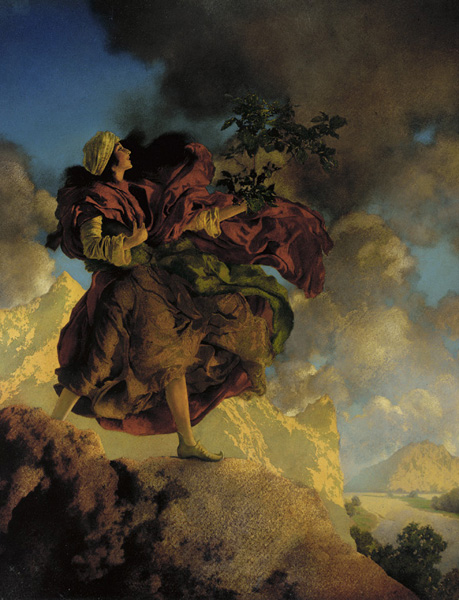
Le Fresne I found to be formulaic, but happy - I was actually more interested in the trope of the separated twins and the foundling child than I was in the actual plot of the story, because this is an archetype that's seen throughout the world. The fact that nobody died is a plus too. I was actually struck by the similarity between Le Fresne and a tale from the Arabian Nights, whose specific title I don't actually know, but is called The Story of the Speaking Bird at this website. In this tale, two sisters are jealous of the other, who is married to the Sultan. They steal each of her three children and replace it with an animal as soon as it's born, and tell the Sultan his wife has delivered a monster. The three children are raised happily by a gardener, ignorant of their heritage. Anyway, I won't spoil it for you, but it was just interesting to note. 


Princess Parizade Bringing Home the Singing Tree, Maxfield Parrish, 1906

And lastly, there is Bisclavret. I liked Bisclavret, not only because I like werewolves, but because the lai was just... funny-ish? It was humorous, in a strange way, because Bisclavret was a different kind of werewolf than we expected. A werewolf here is more akin to "a man wearing a wolf's skin" than a separate supernatural species, kind of like Viking berserkers, who were called that because they wore bear pelts (the ones who wore wolf pelts were called ulfhednar), and changed their mentality but not their form. Here, like in Equitan, there is a form of marital treason at the hands of the wife - a story where Marie is not particularly kind to her own gender, which is interesting to note because she can sometimes vacillate between extremes when it comes to perception of women. 

And to wrap this up, have a lyric video of Arthurian-mythological song about Mordred, and Morgan le Fay. Some of you might have heard it already but... (by the way, this artist specializes in Celtic music, and she is amazing.)


Heather Dale, "Mordred's Lullaby", Avalon or The Trial of Lancelot 


Works Cited: 
  • McDonald, James. "Medieval Torture." Medieval Warfare. Castles and Manor Houses Inc, 11 Apr. 2012. Web. 02 Feb. 2015. 
  • Wikipedia - "Berserker", http://en.wikipedia.org/wiki/Berserker
  • Wikipedia - http://en.wikipedia.org/wiki/File:Princess_Parizade_Bringing_Home_the_Singing_Tree.jpg
  • "THE STORY OF THE SPEAKING BIRD." More Fairy Tales from the Arabian Nights. N.p., n.d. Web. 03 Feb. 2015. 


Monday, January 26, 2015

Amus on, “The Art of Courtly Love”

As I began to contemplate this reading, I skimmed through it and thought, “Nine pages? I can do it”. For the record, I’m not so much into reading for pleasure or just reading period. As I started reading the first chapter, I began to jot down some interesting findings.

A major shock that stood out to me was the first sentence of this reading. “Beauty of the opposite sex,” (Capellanus, 28). Love isn't all about beauty or sex, nor is it only based on the opposite sex. Also, that the same sex is “not fitted for giving each other the exchange of love” (Capellanus, 30). Totally disagree, it can ultimately happen! In our society today, there’s a major debate on same sex-marriage, which I find nothing wrong. Love is held within ourselves and our special someone.
http://merchantsmarketer.com/irs-recognizes-same-sex-marriages-for-tax-returns/
As stated throughout this first chapter, “love is suffering.” People, myself included (no shame!), are scared of what love may hold. What is “single love?” As described in this reading, I immediately thought of cheating and insecurities. I thought to myself, and really agreed that it is a reflection of the mind. The woman has all the power in this court of love; therefore, the men are the ones who are in fear. This is a plus for us females because in the past we didn't have much power as do men.

Now, is money really the answer to love? Or is it what we call, Lust? Yes, love has its ups and down, and can solely be based on wealth. Apparently love increases with wealth, and love decreases with poverty. “Poverty has nothing with which to feed its love” (Capellanus, 30). I totally disagree; we don’t need money to fall in love!

http://www.thefix.com/content/drinking-him?page=all
Amor or Amus? As do fishermen’s, we allure one another into our hook of love! So cheesy, yet so clever.
RULES. RULES. RULES! Does love really have to come with rules? Rules can definitely be strict and precise, but yet awkward. One rule that stood out to me was number 33, which states, “A true lover is constantly and without intermission possessed by the thought of his beloved” (Capellanus, 186). I mean, I understand you’re in love, but the constant thought? That’s a little excessive. Rules are rules, and some may come in handy. Capellanus mentions that men are compared to shameless dogs; they lust for every woman they see. In some cases, he can be right, but not exactly.


Work Cited:

Capellanus, Andrew. "The Art of Courtly Love." New York: Columbia University Press. 1960.
            Print.
Schwartz, Debra. "Backgrounds to Romance: 'Courtly Love.'"California Polytechnic University.
            1998-2002. Web
Thompson, Diane. "Courtly Love Study Guide." Northern Virginia Community College.

 January 26, 2011. Web.