Showing posts with label love. Show all posts

Monday, February 23, 2015

Love Thy Lover With All Thy Heart and Soul and . . . Wait, What?


            One of the most interesting things about “The Knight of the Cart” is the way it approaches piety and faith. As per the norm, characters interact with each other in a deeply Christian age, but Chrétien de Troyes creates a land where faith means different things to different people. The knights in particular approach faith in a different way.
            Lancelot has a shaky manifestation of his faith in God. He starts off fairly merciful and noble, sparing the life of the knight at the ford: “‘I have always shown mercy to anyone . . . if he seeks mercy in the name of God. I do this in God’s name, as is right’” (Chrétien 181). Mercy is one of the core Christian virtues, so Lancelot seems pretty solid in his faith. Things soon change when he beheads the knight who interrupts his meal. That knight also asks for mercy in God’s name, but Lancelot instead sides with “Generosity” and gives the head to a passing maiden who asks for it.


The “dueling virtues” of Generosity and Pity seem pretty strong as Chrétien portrays them, but that is an argument people (myself included) have been using for ages to justify doing something wrong. While Lancelot doesn’t abandon his Christian nature, he certainly diminishes it after losing his mercy.
            Rather than focusing on God, Lancelot spends most of the story fixated on the queen, who, it becomes evident, is an empowering force. One of the biggest examples is when Lancelot breaks open a barred window: “‘I believe these bars to be useless. Only you may prevent me from reaching you. If you grant me permission, [my lady,] my way is clear’” (Chrétien 226). The instance’s significance comes from its resemblance to water-walking miracle from the Bible. Jesus walks across the Sea of Galilee to meet the disciples. Peter responds much like Lancelot does: “And Peter answered Him and said, ‘Lord, if it is You, command me to come to You on the water’” (Matt. 14.28). Clearly, faith is a force that empowers humans to greatness, but in “The Knight of the Cart,” Love is also a force that empowers greatness. It seems like Lancelot puts his love for the queen before his love for God, which is a no-no in traditional Christianity.
            So, I’ve been wondering, can a lover in courtly romance truly be dedicated to his faith? What does it mean to be faithful? Is love greater than faith? I don’t know, but it doesn’t seem like the infatuation of courtly love and faith coexist fairly well; however, Chrétien de Troyes would probably disagree.

***

Additional Works Cited
The New King James Bible. Nashville: Thomas Nelson Publishers, 1982. Print.
 

Monday, January 26, 2015

No Side-Hugs or Supervision? Cool.

                Call me weird, but the first thing I considered when I finished this essay was the definition of “courtly.” I mean, we live in a world where “courting” means side-hugs, no hand-holding (EVER), and constant supervision (thanks a lot, Duggars).  So that was my rather uneducated misconception.  And Capellanus talks A LOT about sex in “The Art of Courtly Love” (and my definition of “courtly” does NOT, under any circumstances have anything to do with sex except for the prohibition of it.) So I was pleasantly surprised when the first sentence I read was, “Love is a certain inborn suffering derived from the sight of and excessive meditation of the beauty of the opposite sex…” (Capellanus).  Now, I think that is simply beautiful; and so is the rest of the sentence, which indicates that this meditation “causes each one to wish above all things the embraces of the other and by common desire to carry out all of love’s precepts in the other’s embrace” (Capellanus).  I really wasn’t expecting to have my mind blown so quickly.
                Mostly, I loved that I found so many similarities between this and our modern conceptions of how we should love.  That being said, I think this guy is one of the reasons why so many women harp on being romantic and all that sappy stuff.  Capellanus describes love, and its rules, in a rather blunt way, but in the same respect, it is also beautiful. 

                My favorite chapter is the one in which he describes, of all things, the TYPES of people who should love.  One difference is that “after the sixtieth year in a man and the fiftieth year in a woman…the natural heat begins to lose its force…” (Capellanus).  This just seems funny to me, because love is all about sex? Um, I think that’s what we’re currently trying to get away from, but it still amuses me.  Similarly, he talks about how no boy under the age of eighteen can be in love because he’s too caught up being clumsy and embarrassed by his genitals.  YES.  It’s so funny how even then men were men and boys were boys.  I was pleasantly comforted by the fact that these people (or their beliefs, rather) weren’t so much different from those we have now.  To put it into perspective, I think it really makes reading the work of this time a lot less daunting.  As long as we can put it into a historical perspective, the basic rules and ways in which they conducted themselves can be translated into something we can understand.  A lot of their social beliefs are the same as ours.  Or rather, they are the ones who paved the way for some of the social constructs we have today.  Pretty cool.  

Sunday, January 25, 2015

Maybe the First and Greatest Love Wasn't Courtly


      As a satire, Andreas Capellanus' The Art of Courtly Love manages to make fun of or tick off pretty much everybody. And here I thought Jonathan Swift was good, but his plan to cannibalize the orphans doesn’t quite measure up to Capellanus’ work. The book’s tongue-in-cheek approach to love kind of mocks the courtiers who swooned (if there was dramatic swooning in the twelfth century) at the idea of a passionate, loving knight in shining armor. Of course, Capellanus probably didn't totally ridicule the idea; I imagine he believed in love between people as well, being that he was a cleric and all.

Eleanor of Aquitaine is not amused.


To make things better, the book is riddled with inside-inside jokes that would have made medieval busybodies seethe with rage. There are numerous subtle twists of Christian doctrine that only a literate person who had read the Bible, essentially only priests and monks (and not even all of them), would understand. Here are a few examples:

1a. “[Love] can endow a man even of the humblest birth with nobility of character; it blesses the proud with humility” (Capellanus 31).
1b.“[The redeemed are] children of God, and if children, then heirs—heirs of God and joint heirs with Christ” (Romans 8:16b-17a). And that “‘the last will be first, and the first last’” (Matthew 20:16).
2a. “A true lover considers nothing good except what he thinks will please his beloved” (Capellanus 185).
2b.“Test all things; hold fast what is good” (1 Thessalonians 5:21). And “'he who does the will of My Father in heaven [shall be saved]'” (Matthew 7:21, which relates to pleasing God). And “He who is unmarried cares for the things of the Lord—how he may please the Lord” (1 Corinthians 7:32).

Not to mention that Capellanus advocates extramarital relationships, a strict taboo in Christian doctrine. I imagine some priests were in stitches as they read The Art of Courtly Love.

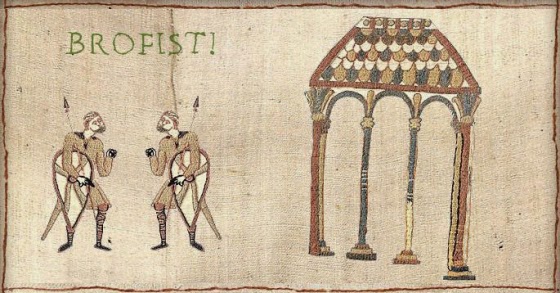
Medieval Fist Bump!


Others might have said, “Andy, my man, we like you, but you took it a bit too far, don’t you think?” That might be why he wrote a third book recanting the first two satires…
            Yet is it possible that Capellanus believed that love was truly powerful, even as he poked fun at courtly love? Perhaps he satirized courtly love in order to differentiate it as a corruption of the love inspired by God. After all, this was a man whose doctrine stated the greatest two commandments were to love God and to love one’s neighbor (Matthew 22). His satire implies that love has a truly divine quality, although courtly love does not. As some historians have pointed out, it is possible The Art of Courtly Love was meant to encourage knights to behave well (Schwartz), but could it have also been meant as a not-so-gentle way to encourage all courtiers to remember God as their first love?
            If so, maybe the priests were right to give him that fist bump after all…