Showing posts with label Halberd. Show all posts

Monday, April 20, 2015

Apparently, the Cambion Can Change

... for the better! 

Overall, I really liked this story. I thought that, unlike some of our previous romances, this one balanced action with the rest of the narrative well. I also liked how even though infidelity is what sets the story in motion, there's very little emphasis on sexual transgression past Sir Gowther's birth. There's little emphasis on romantic relationships at all, which is refreshing - while the maiden is beautiful but mostly mute (which is another discussion for another time), she is not the focus of the story, or Gowther's focus either. They marry in the end once he becomes a better person, no fuss, no drama. While I understand that drama is what makes a romance, I was glad to see a female character who doesn't suffer overmuch. A lot of the action in medieval romances occurs at a woman's expense, like in Emare. I was glad to see that the trend somewhat changed here.

This tale was also sensational, and I am a huge fan of the sensational. I love the supernatural, and the concept of cambions (half-human, half-demon children) is appealing to my love of weirdness and witches and magic and all that fun stuff. I shouldn't have been surprised by the fact that Gowther was a literal hellion, but I was, because I was hoping that he would be his own person and not so... devilish? Murdering people and biting your mother's nipple off is not a great start to life, dude.

   Laverne's Jesus disapproves of your... shenanigans. 

While I liked Sir Gowther's unapologetic murdering (because it was such a non-issue; he just killed people and that was what he did), I have a difficult time really wrapping my head around the fact that, redemption aside, he did kill a lot of people and did a lot of terrible things, and that becoming forgiven doesn't change the fact that those things happened. Just because you're forgiven doesn't mean that everything is fine - the medieval idea of forgiveness and mine are two totally different things, which is sometimes makes things hard in class. 

Even though this is a little paradoxical, I was actually a little sad that Gowther had a literal "come to Jesus" moment. I love monsters, and I love it more when monsters embrace their monstrosity, I'm not quite sure why. 

Sir Gowther, immediately following his... talk... with his mom. 

But really: "oh my god" is a great summary for this tale.

Tuesday, April 14, 2015

The Fluffiest Story Yet

So I actually thought that this was a pretty heart-warming tale. For once it had a man who didn’t jump to conclusions or make rash decisions out of anger. Well, the King of Wales didn’t but the emperor sure did. I mean, he cast his daughter out to sea with only her embroidery because she wouldn’t marry him, and then burst into tears after realizing what he had done.


But anyway, back to the king. He repeatedly ignored the tricks that people were trying to play on him, and instead stood by Emaré and the decision he had made to marry her. The first time this happened was when his own mother tried to tell him that she was nothing more than a fiend in a noble robe. But he didn’t even believe this for a second and instantly shot her down. In any other story he probably would have actually cared about what his mother said and have at least respected her, but not here.


                The next time is more impressive as he was tricked by a false letter. This time he did believe what was said about Emaré birthing a devil, but instead of abandoning or executing her and the child, he tells them to give her whatever she wanted. To me this is really surprising. You can tell just how religious everyone is by all of the references in the story, and you would think that such a devote disciple would have had a stronger reaction to the news of his wife birthing a devil. But nope! He bemoans his luck for a little bit but then decides that he loves his wife more and won’t let this come between them. That is some strong devotion right there.

                And then the ending was a sweet little reunion that  while nice, left me thinking “there is no way that all three of them would go to Rome and accidentally run into each other”. Still a good ending though, so whatever.

Tuesday, April 7, 2015

Where is the Similarity?

When reading Sir Orfeo, I could not help but notice a lack of similarity between it and Orpheus and Eurydice.  In Sir Orfeo, his love/wife is alive, but dead inside.  Whereas, in Orpheus and Eurydice, Eurydice is dead, but alive inside (that she is able and willing to follow her husband).  That is but one difference between the two.  Having long ago been acquainted with the tale of Orpheus and Eurydice and having nothing more than little segments of it in memory, this tale was enough to re-jog the tale to memory.  However, why did I need to know of the tale before or while reading it? I guess I can see where the inspiration for the tale came from that way... but need I really know that?


Confusion aside, continuing on.  One (the tale of Orpheus and Eurydice) was a tragedy, the current reading (the tale of Sir Orfeo) ends on a much more happy note.  In one the love is lost and in the other the love is reacquired and rekindled.


The ending, where the king reappeared in "disguise" and made himself known by a skill in which he could do best (in this case his music playing), made me think of nothing but Odysseus from The Odyssey.  He had numerous suitors that wished to claim his wife, but in order to do so, they had to string his bow and, with it, shoot an arrow very accurately.  None of the suitors were capable of accomplishing this task... but along came Odysseus, disguised as an old man (in our current story Sir Orfeo is disguised as a ragged minstrel) strung his bow and, with it, not only did he shoot the very accurate shot correctly, but also slaughtered all the suitors who had been ransacking his household.  Unfortunately (at least from my messed up point of view), Sir Orfeo had no one to slay, as once his identity was discovered, he and his wife were warmly welcomed back and reseated upon the throne.
I end my post with this question:  As I saw a lot more similarities (at least in regards with how the story ended) to The Odyssey, why did we not need to have a background of it as well?

Monday, April 6, 2015

The Classics Never Die

It's been how many thousands of years, and Greek mythology still informs how much of Western culture? It doesn't matter; it's so interesting to see how these legends evolved!

Sir Orfeo is a retelling of the Orpheus legend, which is one of my favorite Greek myths of all time - emphasis on the retelling of the story, because it isn't the same as the original myth. To be fair, ancient Greek myths were so heavily regionalized and re-purposed (depending on who was in charge at the time) that it's hard to find just one to be considered canon, so maybe Sir Orfeo isn't as far off-base as I think it is. Honestly, who knows? 

The first thing that popped into my head about Sir Orfeo is that, aside from the Breton influence there, it almost seems to be a convergence of two myths rather than just Orpheus's tale. The abduction of Herodis into the "underworld" has much more in common with the legend of Persephone and Hades than it does in the so-called "standard" Orpheus myth, where [SPOILER]: Herodis (Eurydice) is killed by a snakebite, and Orfeo/Orpheus descends to rescue her. 


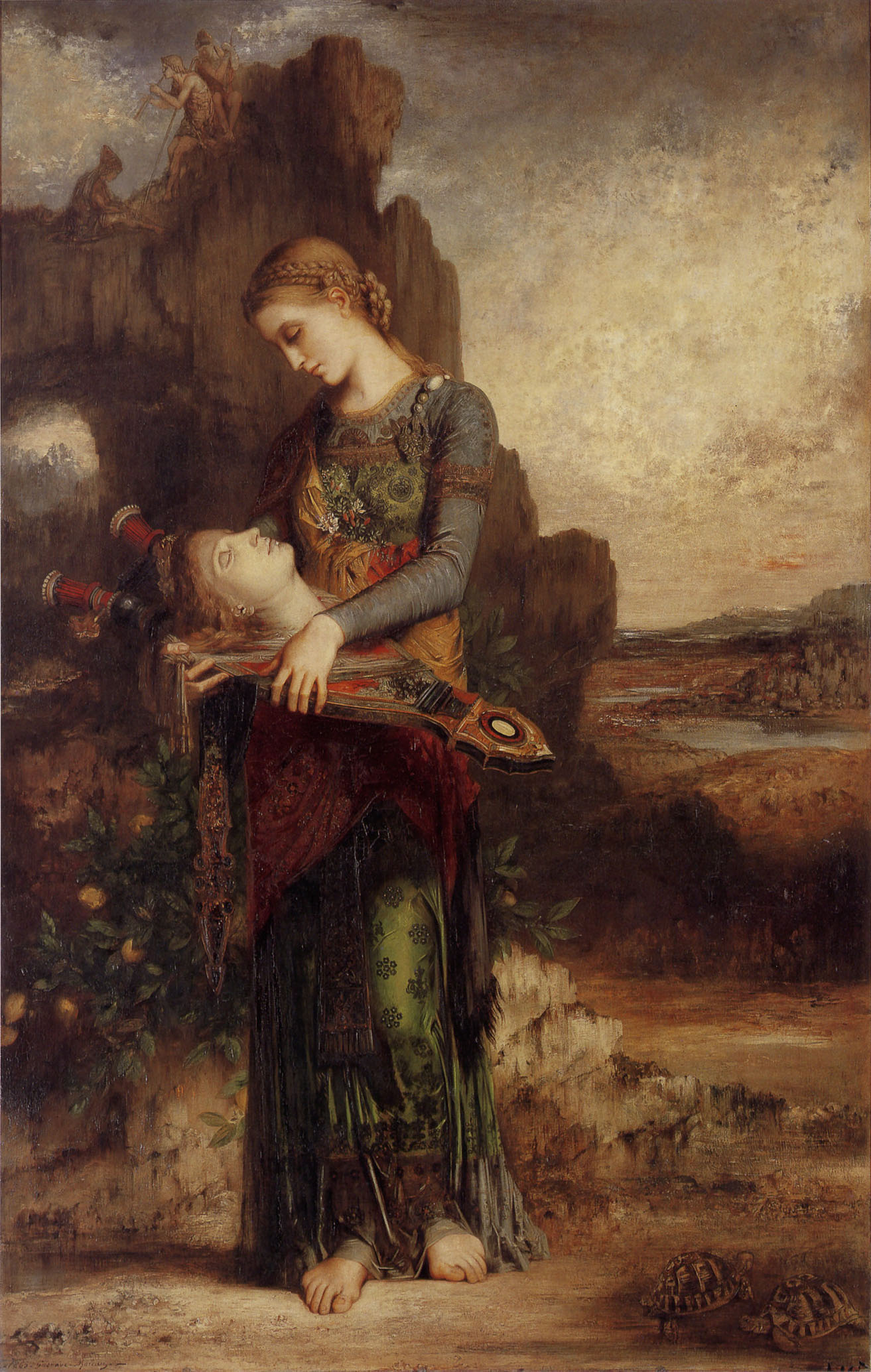
Thracian Girl Carrying the Head of Orpheus on His Lyre, Gustave Moreau, 1865

I thought it was interesting that the story's ending was changed into a happy one. I don't know why the ending was changed - my guess it was an attempt by the author to make the story more accessible to a newer, more modern audience? But several of the stories we've read were incredibly brutal and violent. What makes a husband losing his wife through his lack of willpower/emotional devastation and then being torn apart by drunk Dionysus groupies any different than a head getting chopped off or a poker up the ass? All of those things kind of exist in the same vein. There's no reason the author couldn't make it more like a traditional romance, unrealistic violence and all. 

This story was a change, because there wasn't really any violence or political intrigue. It wasn't quite... boring, but it also wasn't as bombastic as, say, the Knight of the Cart or the Knight's Tale. 

Not present in the story: rippling muscles.
Also not present: pretty much any action at all.

The one thing that irritated me about Sir Orfeo is that there isn't a reason given as to why Herodis is abducted. It just seems like the king of the underworld showed up in a dream and kind of told her he was gonna grab her for no good reason. Am I missing something? 

Overall, I really liked this story, if only because I enjoy the Orpheus legend and all its various forms, even Tennessee Williams' Orpheus Descending which follows the legend but... in a really abstract way? What even happened there? Anyway, Sir Orfeo is an interesting take on a very archetypal myth. 


Tuesday, March 31, 2015

Divine Intervention? More like Godly Playtime

As I was reading this, one thing that really stood out to me was the Gods’ interventions. There was only the one small part where one of them physically intervened (when they killed Arcite), but when I looked at it a second time, I saw that their responses actually foreshadowed the result of the battle.


                When Palamon visited the temple of Venus, he never got a definite answer that he was going to win the fight, but we later read that her father was going to do something to make sure that her champion wins Emelye. And what do you know, they were right! Palamon was never told that he would win so he lost the battle, but then Arcite was killed so he was the only one left to marry Emelye.
                Then there was Arcite. He went to Mars and prayed for victory in battle, but doesn’t even mention Emelye. So what does he get? He wins but doesn’t get the girl, exactly what was promised to him. Although, I have to admit that his whole section really annoyed me. The only reason he entered this fight is because he thought that he love/deserved Emelye more than Palamon. But when it came time to actually fight for her, he completely forgets about her! Is that what he calls love? Because it just seems like a bad case of possessiveness to me. He saw something pretty so he wanted it.
                And then there was Emelye. Oh man did this piss me off! She went to the temple of Diana to beg to keep her chastity and not have to marry one of them, but she was basically patted on the head and told “that’s nice”. I know they didn’t really care about what women thought about marriage at that time, but she literally begged! And no one cared! She was stuck doing what everyone else told her to do.


So yeah, needless to say: I didn’t like this part. All of their actions annoyed me (except for Palamon because he did actually do this for love), and the gods just messed with things for kicks and giggles.

Tuesday, March 24, 2015

"She turned me into a newt... I got better"


Clearly, plain and simple, she is a witch!


First Reason:
                She appears in an isolated forest clearing that would seem quite out of the way.  Did she just magically teleport there or something?  He arrived there by horse, but it said nowhere in the text that she had any horse.  Second, what does she eat?  Nowhere in the text does it mention dead animal carcasses surrounding the forest clearing.


Second Reason:
                Her first appearance is in place of the disappearance of twenty-four dancing virgins.  So are twenty-four dancing virgins a metaphor for the youth that she, being the witch that she is, has left?
Third Reason:
                She turns from the world’s ugliest old hag into a beautiful fair maiden in one day’s time.  How is this even possible?  Clearly, because she is a witch it was possible!
Fourth Reason:
                But what is the nature of a witch but to be wise and full of trickery.  Seeing the knight on the way home to face his punishment, what better victim could one find.  Using his desperation to her advantage, she provides him with his answer but at an unset price (does that not sound like a witch, to have one owe her favors, but never owe others favors herself).  Later, when she comes to collect on the promise set, she asks that of him that would irk any young man in his place the most.  She, most likely, enjoyed watching him squirm and lament once her will was stated.
I think after these four reasons, my assessment that she is indeed a witch is backed.  Now, is she a wise witch?  I am going to say, “Yes!”  The fact that she is pressing the knight to marry someone as hideous as she is bad enough, but he has no proof to claim she is a witch.  By the time that he does have proof, in which to try her as a witch, he has fallen in love with her (especially with her body now being that of a young maiden).  She played her cards right and things went exactly as she probably intended.  She gained the very power over her husband that all woman wished for, but needed no magic to do so.  With that, I back my claim that she is indeed wise and with her reacquired youth, she is, indeed, a witch!

Monday, March 23, 2015

The Fun of Middle English

I'm going to do something a little different and not about the story but about Middle English. I much prefer the sound of Middle English to modern English. Don't take this to mean I can speak it (I am awful at speaking modern English and that's my native tongue) nor should I lie and say it is easy to read. I like my standardized spelling, dammit! But it's so much more rhapsodic. As I read it aloud as practice to myself and for my shame haven't improved my diction but I have noticed some things…

I am speaking in some weird Scottish/Irish mix since Mitchell-Buck read it aloud in that way. And something else weird is appearing in my pronunciation. About a year ago I helped my girlfriend with her German flashcards and let a friend practice his Norwegian by speaking it to me and because of that experience I'm noticing a pattern of spelling reminiscent to those languages even if there are no formal rules to spelling in Middle English. Heck, you might’ve even read the same word spelled different times each time! This definitely makes the reading hard but maybe I find it appealing in the same way I find a puzzle appealing…

Anyway, Germanic roots! So it feels like I’m speaking German or Norwegian but I actually know what I’m saying. I’m even tempted to pronounce “w” as “v.” I’ve also read Old English which really does seem like Norwegian to me but with more letters (especially since Thorn is such a fun letter).

O Futhark, my old Norse friend…


Now that’s old Nordic runes. Looks a lot like English, huh? That’s what I thought, too. Good thing the language I took in high school and college is Latin! Six years! Still have no idea how to translate… But it does provide insight to English! Namely, we use the Latin alphabet which was modified from Greek which was modified from Phoenician (which oddly isn’t spelled phonetically?). The words are still misspelled but they are pronounced more similarly to their Latin roots. For example, “auctoritee” from the first line of the prologue is supposed to be authority but looks more like “auctoritas,” the same exact meaning but pronounced differently. It’s things like that I find more interesting; that in about 2500 years not a lot about language has changed but those little differences make the past difficult to understand and life hell for college English students.


-Brian Edwards

Kneeghts and Fayerays: Every Middle (English) Man for Themselves

This story was a complete and total whirlwind. I've never read Middle English before, so I decided that it would be best to read the entire thing out loud and get a feel for the words. It is so very, very difficult not to say knight as nite instead of KNEECHT and might as MEECHT, but it was a learning experience, and was actually really enjoyable and hilarious.   


Im heer to ruine alle youre lives. 

That being said, I did like the story overall. I thought there was a bit of a change in the Wife's sermon now that we read it in the original text, that there was more emphasis placed on poverty than what the modern English version had given us. Maybe it's just because it's a different form of English, but I felt there was a lot more emphasis placed on the socioeconomic status of the wife. 

I also felt it was easier to disconnect from the kneecht and his crime, maybe because it takes a little longer to process the words, but...  I didn't see too much emphasis on character? I mean, there are Distinct People here who Do Things, but aside from the fact that the kneecht is a completely shitty person, there's not a lot of who they are. I couldn't really feel much personality from any of them, which is always strange for me in a piece of literature. 

(and now I'm going to forever refer to "knights" as "kneechts" and no one can stop me)

Tuesday, February 24, 2015

PMS?

So I was really confused about Guinevere’s behavior. When she first heard about Lancelot’s arrival and his fight, she asked the king to place her somewhere that allowed her to see everything. But the only thing she did while there was tell her maid his name and then tell him to stop (which lead to him being attacked again and she didn’t even care that it was her fault that he didn’t defend himself).

                And when she finally sees Lancelot, all beaten up from his trip over the sword bridge and his fight with Meleagant, she just brushes him off and says that he cannot please her.


And then she further insults him by saying that everything he did was worthless because she would only leave if Gawain came and got her. I mean, Lancelot just defeated the king’s son and is basically falling all over himself to please you and you’re just like “nope, go home”. Really?

 We don’t actually see any sign of her caring for him until after she hears that he died, had a full-on melt-down, claimed that everything she said was in jest and that he should have known that. So does that mean that they are close enough that they should know those kinds of things about each other? Because Lancelot implied earlier that he hadn’t really had her in any way, so they couldn’t be lovers before now, and Lancelot didn’t even have a clue about what she was thinking, so they couldn’t have been very good friends.

                It got even more confusing when she later told Lancelot that she rejected him because he hesitated for two steps before entering the cart. But when she was repenting before she said it was just a joke, so which is it?


                But hey, I guess it doesn’t really matter since they made up and had sex in the end.

Monday, February 23, 2015

Meleagent the Evil-Doer!

I have to love this guy because he is the essence of our modern villain. Shows up to a party, steals a queen, then tries killing the hero in the end? Perfect character trope in the making! You can almost imagine Meleagent’s armor is black and red whereas Lancelot’s is blue and silver. The best Darth Vader ever did was kidnap his own princess daughter and try killing his son (and no, Tarkin was the one to destroy Alderaan so Vader can’t even put that on his resumé). Nevertheless, child abuse is evil, too, but far less classy than party crashing.

Plus, I like pretending his name is secretly an old French pun for "evil-doer." See, the stem "mal," means evil, and "agent" is someone who does something.

Like many hated villains, he has an older, wiser advisor. And like the most evil of those villains, that advisor is his dad. Even he wants Meleagent to chill before he gets his ass handed to his angsty self by our knight in shining armor. Our evil-doer is starting to seem less like Vader and more like whiny Anakin.

George Lucas is the real villain.

So like civilized nobles the hero and villain decide to resolve their conflict by murdering each other! Standard procedure, villain loses his arm gets punched in face. Yet it’s not very gratifying. And that bugged me! He’s evil but we don’t get the full impact of hating him like Lancelot hates him. It's because we don't get a good reason to hate him because we only see him as an actual actor nearing the end. That’s way too late to start a compelling relationship between character and audience.


Still, Meleagent lives up to his villain status in the end by basically yelling, “I’ll get you for this!” Too bad he can't keep his head to deliver said revenge. He would’ve won if he were better armed.

Me laughing at my own dumb puns.

Monday, February 16, 2015

Knights, Dwarfs, and Carts - Oh My!

Okay, first thing I noticed about this story: Chretien de Troyes really likes including dwarfs. I'm not sure what's up with that, but there was a dwarf in Erec and Enide, and now there's one here, and they're both equally nasty and gross. Dwarfs are "ill-born and ill-bred" (pg 174) - I wonder if this has anything to do with re-purposing old Germanic/Celtic pagan legends, but that's something of a long shot. It also doesn't help that whenever I think of these dwarves, I think of the Keebler elves.


I didn't choose the the thug life, the thug life chose me.

 I was a little confused as to why a cart would be a bad thing, because a cart, in my head, was just the same thing as a wagon, even though the text explains it, kind of? It is not a wagon? There seems to be some weird hierarchy of wooden transportation devices, which is confusing? Was it because carts were associated with poop and criminals and shame? 

I would appreciate it if Chretien de Troyes would use more proper names - between "the knight", "the knight", "the knight", and "the other knight", I have no idea who anyone is, unless you are "of the cart" or "Sir Gawain". The entire exchange between the knight of the cart and the knight of the ford (?) reminded me a lot of the thumb-biting exchange in the beginning of Romeo and Juliet, which was hilarious. 


I can tell that the knight of the cart is in love with someone, but who? He's distracted for seemingly no reason and just kind of... mopes... while trying to rescue the queen, who is one of the many young ladies Chretien references??? I admit, this story is rather difficult for me to follow because Chretien likes to jump around a lot and reference people indirectly. I'm still not 100% sure what's going on. 

Monday, February 2, 2015

Cultural Connections

So, this week we're to have read three more lais for class: Equitan, Le Fresne, and Bisclavret. I have to say that I was way more enamored with these stories than I was with Lanval, though that wasn't Lanval's fault - I just like adultery, near-infanticide, and werewolves a bit more than I like mopey knights and possibly-fae ladies romancing them and saving the day (you go, fairy lady). I like drama and intrigue, and there was a lot of that in the readings for this week. 

Out of all of these, I was most surprised by Equitan. I was expecting them to get their comeuppance somehow, because they both cheated and that violates the rules, but getting boiled alive was a little bit extreme I thought. I did do an image search to see if there were any period cartoons to describe this, as it was a real way that medieval prisoners were tortured, and oh! fun fact: Google actually auto-filled "medieval boiling torture" as a search parameter. I'm slightly disturbed. But what I thought was interesting was that this search directed me to this website (warning: if you're easily triggered by violence and/or torture devices, I would stay off this page), which stated that "torture was used almost exclusively for the crime of treason" - if you consider cheating on your spouse, who you married before the eyes of God and the government and the universe, a form of treason, then was their punishment deserved? 

(Obviously, cheating is wrong unless you're both into that, but death is a little over-the-top. You shouldn't let your marital problems come to a boiling point.) 


Knight on the left is like, "you're so going to hell, dude." 

Le Fresne I found to be formulaic, but happy - I was actually more interested in the trope of the separated twins and the foundling child than I was in the actual plot of the story, because this is an archetype that's seen throughout the world. The fact that nobody died is a plus too. I was actually struck by the similarity between Le Fresne and a tale from the Arabian Nights, whose specific title I don't actually know, but is called The Story of the Speaking Bird at this website. In this tale, two sisters are jealous of the other, who is married to the Sultan. They steal each of her three children and replace it with an animal as soon as it's born, and tell the Sultan his wife has delivered a monster. The three children are raised happily by a gardener, ignorant of their heritage. Anyway, I won't spoil it for you, but it was just interesting to note. 


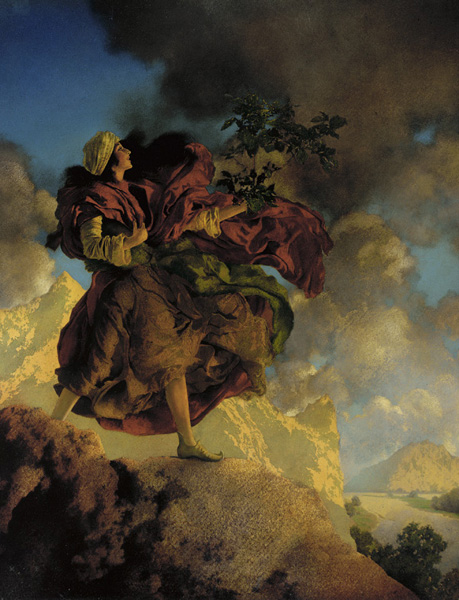
Princess Parizade Bringing Home the Singing Tree, Maxfield Parrish, 1906

And lastly, there is Bisclavret. I liked Bisclavret, not only because I like werewolves, but because the lai was just... funny-ish? It was humorous, in a strange way, because Bisclavret was a different kind of werewolf than we expected. A werewolf here is more akin to "a man wearing a wolf's skin" than a separate supernatural species, kind of like Viking berserkers, who were called that because they wore bear pelts (the ones who wore wolf pelts were called ulfhednar), and changed their mentality but not their form. Here, like in Equitan, there is a form of marital treason at the hands of the wife - a story where Marie is not particularly kind to her own gender, which is interesting to note because she can sometimes vacillate between extremes when it comes to perception of women. 

And to wrap this up, have a lyric video of Arthurian-mythological song about Mordred, and Morgan le Fay. Some of you might have heard it already but... (by the way, this artist specializes in Celtic music, and she is amazing.)


Heather Dale, "Mordred's Lullaby", Avalon or The Trial of Lancelot 


Works Cited: 
  • McDonald, James. "Medieval Torture." Medieval Warfare. Castles and Manor Houses Inc, 11 Apr. 2012. Web. 02 Feb. 2015. 
  • Wikipedia - "Berserker", http://en.wikipedia.org/wiki/Berserker
  • Wikipedia - http://en.wikipedia.org/wiki/File:Princess_Parizade_Bringing_Home_the_Singing_Tree.jpg
  • "THE STORY OF THE SPEAKING BIRD." More Fairy Tales from the Arabian Nights. N.p., n.d. Web. 03 Feb. 2015.