Sunday, January 25, 2015

Maybe the First and Greatest Love Wasn't Courtly


      As a satire, Andreas Capellanus' The Art of Courtly Love manages to make fun of or tick off pretty much everybody. And here I thought Jonathan Swift was good, but his plan to cannibalize the orphans doesn’t quite measure up to Capellanus’ work. The book’s tongue-in-cheek approach to love kind of mocks the courtiers who swooned (if there was dramatic swooning in the twelfth century) at the idea of a passionate, loving knight in shining armor. Of course, Capellanus probably didn't totally ridicule the idea; I imagine he believed in love between people as well, being that he was a cleric and all.

Eleanor of Aquitaine is not amused.


To make things better, the book is riddled with inside-inside jokes that would have made medieval busybodies seethe with rage. There are numerous subtle twists of Christian doctrine that only a literate person who had read the Bible, essentially only priests and monks (and not even all of them), would understand. Here are a few examples:

1a. “[Love] can endow a man even of the humblest birth with nobility of character; it blesses the proud with humility” (Capellanus 31).
1b.“[The redeemed are] children of God, and if children, then heirs—heirs of God and joint heirs with Christ” (Romans 8:16b-17a). And that “‘the last will be first, and the first last’” (Matthew 20:16).
2a. “A true lover considers nothing good except what he thinks will please his beloved” (Capellanus 185).
2b.“Test all things; hold fast what is good” (1 Thessalonians 5:21). And “'he who does the will of My Father in heaven [shall be saved]'” (Matthew 7:21, which relates to pleasing God). And “He who is unmarried cares for the things of the Lord—how he may please the Lord” (1 Corinthians 7:32).
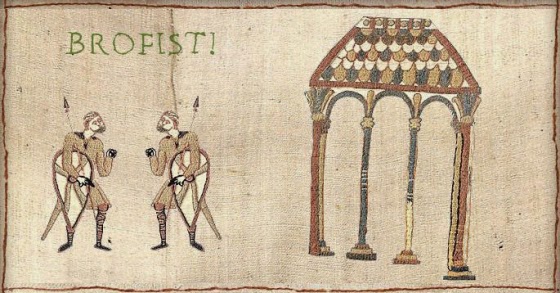
Not to mention that Capellanus advocates extramarital relationships, a strict taboo in Christian doctrine. I imagine some priests were in stitches as they read The Art of Courtly Love.

Medieval Fist Bump!


Others might have said, “Andy, my man, we like you, but you took it a bit too far, don’t you think?” That might be why he wrote a third book recanting the first two satires…
            Yet is it possible that Capellanus believed that love was truly powerful, even as he poked fun at courtly love? Perhaps he satirized courtly love in order to differentiate it as a corruption of the love inspired by God. After all, this was a man whose doctrine stated the greatest two commandments were to love God and to love one’s neighbor (Matthew 22). His satire implies that love has a truly divine quality, although courtly love does not. As some historians have pointed out, it is possible The Art of Courtly Love was meant to encourage knights to behave well (Schwartz), but could it have also been meant as a not-so-gentle way to encourage all courtiers to remember God as their first love?
            If so, maybe the priests were right to give him that fist bump after all…


Oh, so many things to say about "The Art of Courtly Love"


          Opening today’s reading on blackboard, I am more than pleased to find that the document is only nine pages long. I start reading the first chapter aloud, adding some flare in the form of a British accent in order to keep myself entertained (don’t worry, none of my roommates are home to suffer through this performance).

          “Love is a certain inborn suffering,” I read (Capellanus, 30). Wow, Capellanus really hit the nail on the head with that one. I’m beginning to think I can agree with what this author has to say.  In the twenty-two years that I have been me, I have come to find that even the best types of love occasionally suck. It’s hard work, this business of love. And after years of being a self-absorbed and, to be quite honest, an idiotic teenager, I have come to the same realization that Capellanus does on the next page: most of the problems with love, are problems which are created in our own minds. The dilemma with this theory though, is that I can easily argue in defense of worrisome thoughts toward love. Ignoring your instincts can be just as dangerous as heartbreak. And sometimes the problems that arise from “overthinking,” should not be ignored. Perhaps Capellanus should read a little bit more…
http://sweatpantsandcoffee.com/body-mind-soul/moment-of-sanity-what-depression-and-anxiety-look-like-to-me/

        I continue to read, and before I know it, I’m laughing—laughing at my own ignorance of course! You see, I’ve gone my entire life believing that blind people have the ability to love, along with women who are older than 55, men older than 60, and people who do not consider jealousy a necessary trait. How could I have been so foolish?
http://nishanrl-journal.blogspot.com/2012/01/carl-ellie.html
          When I think about it though, it is Disney who filled my head with such lies. 

          Rereading the rules of courtly love, I find myself stuck on XXIII. It reads: “He who love vexes eats and sleeps very little.” Well now I KNOW that this piece isn’t factual. Because along with my twenty-two years of experience on love, I have found that I NEVER (and I mean NEVER) have an issue with my appetite. I’m thinking I could make a lot of money writing a story similar to this one, titled: The Art of Courtly Love: Doughnut Edition. 

   https://foodiegang.wordpress.com/2010/02/03/heart-shape-donuts-valentine%E2%80%99s-day-special/
 What do you think of this as the cover?

                Alas, I shall press on to more serious questions about this reading. One of the most unexpected pieces of information comes halfway through the first study guide.  Reading that the doctrine was created by women makes me feel somewhat betrayed. The Middle Ages wasn’t a great time to be a woman. But I find myself wondering if maybe these women hurt themselves even more by making such rules for men. I’d like to think that if I were living during that time, I would have the guts to give up on people who needed a list of the “do’s and don’ts” of loving another person. It’s laughable (the kind of laugh that turns quickly into tears of disappointment) to realize that these women had to find a nice way to say, “by the way, rape isn’t okay. Oh and also, love is a lot better if it’s a mutual feeling.”

          And after all of my anger dissipates, I come to realize that this is the most entertaining thing I have read in quite some time. So, maybe it was worth something after all? 


Work Cited: 

Capellanus, Andrew. "The Art of Courtly Love." New York: Columbia University Press. 1960. Print. 

Thompson, Diane. "Courtly Love Study Guide." Northern Virginia Community College. January 26, 2011. Web. 

Schwartz, Debra. "Backgrounds to Romance: 'Courtly Love.'"California Polytechnic University. 1998-2002. Web.