Monday, January 26, 2015

Of Love and the Law


“The Art of Courtly Love” reading was filled with so many contradictions that I found myself simultaneously outraged and amused. I did not even reach the actual laws of love before I found myself going, “WHAT?!?!” In the beginning of the reading the author wrote about who was eligible for courtly love. Amongst those who were not allowed were the blind, and the homosexuals. I thought it was absolutely ridiculous that the basis of courtly love is based solely on physical beauty. “Blindness is a bar to love, because a blind man cannot see anything upon which his mind can reflect immoderately, and so love cannot arise in him…” (33)


In addition to the blindness aspect of love, I hated reading about the denial of love for two same sex people. I understand that this piece was written in the twelfth century but even so, the issue of equal rights for same sex couples in today’s society is quite prevalent. And what is even more interesting is that (I am a history major) in medieval times homosexuality was common, especially in the royal classes.


To acknowledge that actual laws of love, one of the rules that I found absolutely ridiculous was the 33rd rule which states, “A true lover is constantly and without intermission possessed by the thought of this beloved.” (186) That just sounds absolutely obsessive and while it did not surprise me, it made me cringe while I read it. Who wants to be with a partner who has no others thoughts or passions besides the one he loves? Sounds horrible to me.


In connection to today’s society, I found an immediate thread between one of the laws and one of the popular movies and books from today’s culture. The fourteenth law states, “The easy attainment of love makes it of little value; difficulty of attainment makes it prized.” (185) This is a very prosaic way of saying, love is increased by playing hard to get. This ideal is shown in the most hilarious way in the book and film, Pride and Prejudice. When Elizabeth turns down her awkward suitor Mr. Collins, the man is convinced that Elizabeth is just saying no to “increase my love by suspense” as Mr. Collins would say. Elizabeth reassures him that she is not at all the kind of woman that would do that but Mr. Collins still thinks that all females exercise this cat and mouse dance with their suitors to increase the feelings of love. It is this idea that “no” does not actually mean “no”.


Works Cited:

Austen, Jane. Pride and Prejudice, Directed by Joe Wright, 2005. Movie.


Capellanus, Andrew. "The Art of Courtly Love." New York: Columbia University Press. 1960. Print. 

Sunday, January 25, 2015

Maybe the First and Greatest Love Wasn't Courtly


      As a satire, Andreas Capellanus' The Art of Courtly Love manages to make fun of or tick off pretty much everybody. And here I thought Jonathan Swift was good, but his plan to cannibalize the orphans doesn’t quite measure up to Capellanus’ work. The book’s tongue-in-cheek approach to love kind of mocks the courtiers who swooned (if there was dramatic swooning in the twelfth century) at the idea of a passionate, loving knight in shining armor. Of course, Capellanus probably didn't totally ridicule the idea; I imagine he believed in love between people as well, being that he was a cleric and all.

Eleanor of Aquitaine is not amused.


To make things better, the book is riddled with inside-inside jokes that would have made medieval busybodies seethe with rage. There are numerous subtle twists of Christian doctrine that only a literate person who had read the Bible, essentially only priests and monks (and not even all of them), would understand. Here are a few examples:

1a. “[Love] can endow a man even of the humblest birth with nobility of character; it blesses the proud with humility” (Capellanus 31).
1b.“[The redeemed are] children of God, and if children, then heirs—heirs of God and joint heirs with Christ” (Romans 8:16b-17a). And that “‘the last will be first, and the first last’” (Matthew 20:16).
2a. “A true lover considers nothing good except what he thinks will please his beloved” (Capellanus 185).
2b.“Test all things; hold fast what is good” (1 Thessalonians 5:21). And “'he who does the will of My Father in heaven [shall be saved]'” (Matthew 7:21, which relates to pleasing God). And “He who is unmarried cares for the things of the Lord—how he may please the Lord” (1 Corinthians 7:32).

Not to mention that Capellanus advocates extramarital relationships, a strict taboo in Christian doctrine. I imagine some priests were in stitches as they read The Art of Courtly Love.

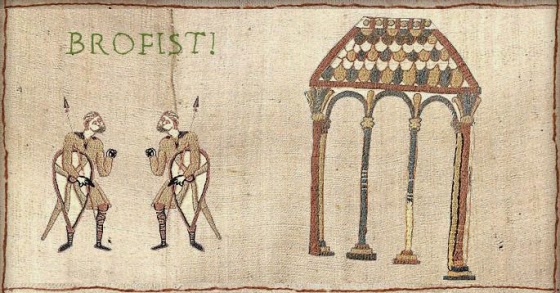
Medieval Fist Bump!


Others might have said, “Andy, my man, we like you, but you took it a bit too far, don’t you think?” That might be why he wrote a third book recanting the first two satires…
            Yet is it possible that Capellanus believed that love was truly powerful, even as he poked fun at courtly love? Perhaps he satirized courtly love in order to differentiate it as a corruption of the love inspired by God. After all, this was a man whose doctrine stated the greatest two commandments were to love God and to love one’s neighbor (Matthew 22). His satire implies that love has a truly divine quality, although courtly love does not. As some historians have pointed out, it is possible The Art of Courtly Love was meant to encourage knights to behave well (Schwartz), but could it have also been meant as a not-so-gentle way to encourage all courtiers to remember God as their first love?
            If so, maybe the priests were right to give him that fist bump after all…