Monday, February 2, 2015

Evil Wifes, Long Lost Daughters, and Werewolfs By: Ariana Moore


First off, I have to say that these lais are very entertaining to read. I absolutely loved these stories. I believe that Marie de France was feeling some type of way when she wrote these lais. All of these stories captured my attention with all the betrayal, secrecy, and mystical creatures and most books or short stories don't always capture my attention. In Equitan, the betrayal of the wife for the King was epic. This story reminded me of the Story of David in the Bible. Just like how the king sought after David's wife, the king wanted to fulfill his own desire's with the seneschals wife. The fact that she gives in to the king's desires is not surprising to me. Females can be very devious and evil. The ending has to be my favorite part where the king and seneschals wife get caught in their own plot. The tub of hot boiling water becomes both of their way of  death. The moral of this story was a good one, "He who plans evil for another may find the evil falling upon himself".


Le Fresne was a really sweet story. I didn't think that the wife had to go and bash the other wife for having twins, but hey karma is a bitch! This is a smooth point of why you shouldn't talk bad about people. Since she had spread a rumor about the other wife, she had to give up her own child just so she wouldn't contradict herself. That my friends is very sad and that's what she gets for spreading lies. Later on when the daughter returns after her lover was suppose to marry her twin sister, I thought that was a beautiful family moment. Just like the Parent Trap movie both sisters found their way back to each other unexpectedly which was really sweet.


Now I love mystical characters, creatures, and fantasies. This story had the most action and thrill. I know when people think of werewolf's everyone screams "Twilight".  I have seen classic black and white movies that have the werewolf theme and that was my thought of what werewolf's would be in medieval times. I couldn't stand why the wife couldn't accept the fact that her husband was a werewolf. And when he ran off for quite sometime into the woods, she just decided to up and marry someone else. At that point she deserved to be bitten in the nose by her ex-husband. She should've stayed and helped him through his problem. See females today, when things get to tough or they don't like something that their "significant other" does they would just up leave. In the end at least he gets changed back into a human, but its still cool that he becomes a werewolf. He was about that life.


Cultural Connections

So, this week we're to have read three more lais for class: Equitan, Le Fresne, and Bisclavret. I have to say that I was way more enamored with these stories than I was with Lanval, though that wasn't Lanval's fault - I just like adultery, near-infanticide, and werewolves a bit more than I like mopey knights and possibly-fae ladies romancing them and saving the day (you go, fairy lady). I like drama and intrigue, and there was a lot of that in the readings for this week. 

Out of all of these, I was most surprised by Equitan. I was expecting them to get their comeuppance somehow, because they both cheated and that violates the rules, but getting boiled alive was a little bit extreme I thought. I did do an image search to see if there were any period cartoons to describe this, as it was a real way that medieval prisoners were tortured, and oh! fun fact: Google actually auto-filled "medieval boiling torture" as a search parameter. I'm slightly disturbed. But what I thought was interesting was that this search directed me to this website (warning: if you're easily triggered by violence and/or torture devices, I would stay off this page), which stated that "torture was used almost exclusively for the crime of treason" - if you consider cheating on your spouse, who you married before the eyes of God and the government and the universe, a form of treason, then was their punishment deserved? 

(Obviously, cheating is wrong unless you're both into that, but death is a little over-the-top. You shouldn't let your marital problems come to a boiling point.) 


Knight on the left is like, "you're so going to hell, dude." 

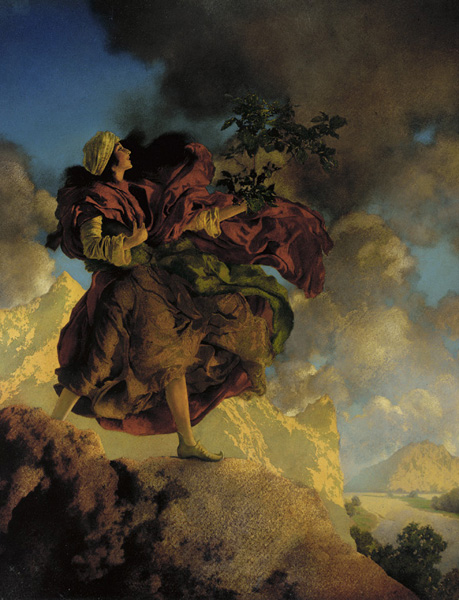
Le Fresne I found to be formulaic, but happy - I was actually more interested in the trope of the separated twins and the foundling child than I was in the actual plot of the story, because this is an archetype that's seen throughout the world. The fact that nobody died is a plus too. I was actually struck by the similarity between Le Fresne and a tale from the Arabian Nights, whose specific title I don't actually know, but is called The Story of the Speaking Bird at this website. In this tale, two sisters are jealous of the other, who is married to the Sultan. They steal each of her three children and replace it with an animal as soon as it's born, and tell the Sultan his wife has delivered a monster. The three children are raised happily by a gardener, ignorant of their heritage. Anyway, I won't spoil it for you, but it was just interesting to note. 


Princess Parizade Bringing Home the Singing Tree, Maxfield Parrish, 1906

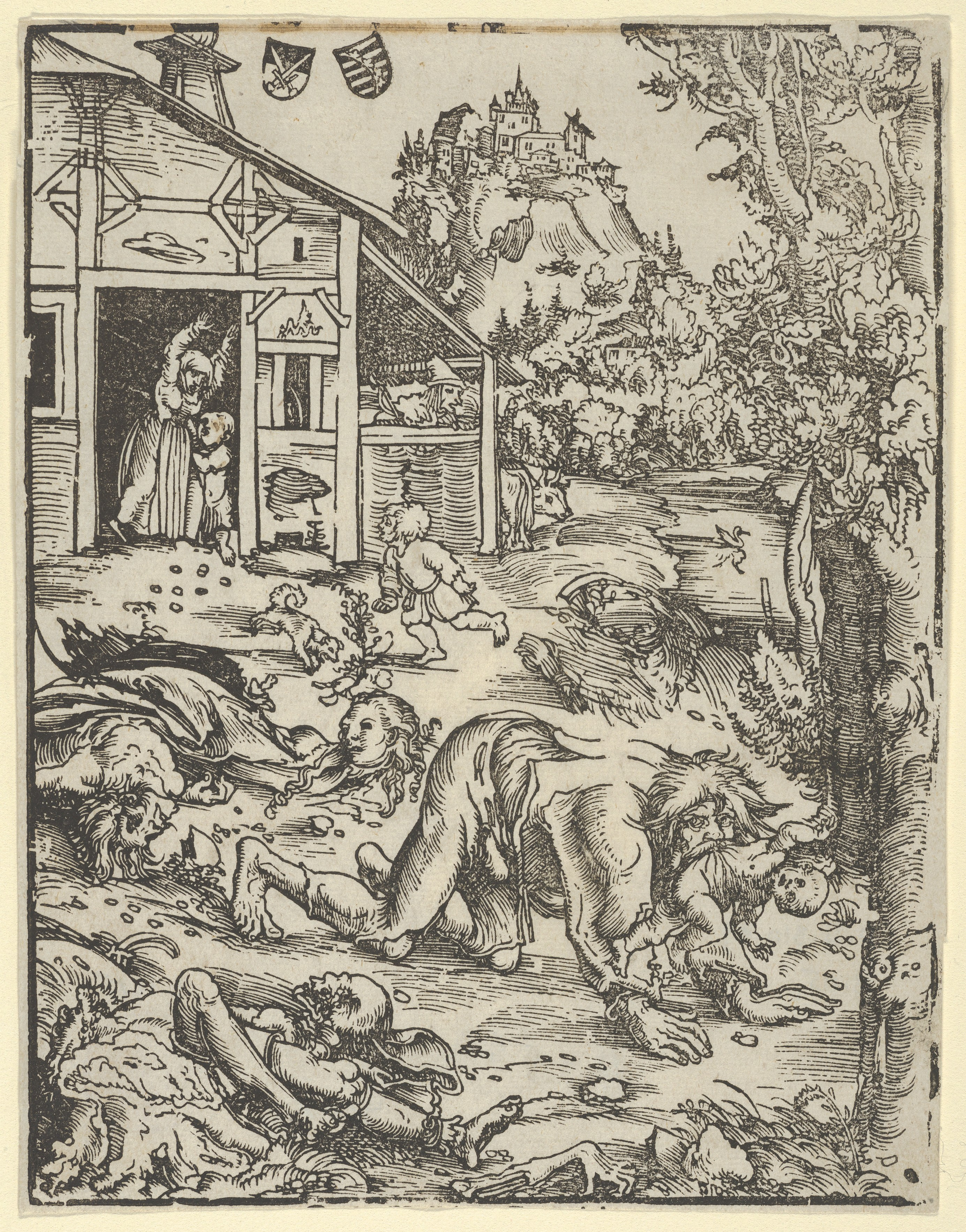
And lastly, there is Bisclavret. I liked Bisclavret, not only because I like werewolves, but because the lai was just... funny-ish? It was humorous, in a strange way, because Bisclavret was a different kind of werewolf than we expected. A werewolf here is more akin to "a man wearing a wolf's skin" than a separate supernatural species, kind of like Viking berserkers, who were called that because they wore bear pelts (the ones who wore wolf pelts were called ulfhednar), and changed their mentality but not their form. Here, like in Equitan, there is a form of marital treason at the hands of the wife - a story where Marie is not particularly kind to her own gender, which is interesting to note because she can sometimes vacillate between extremes when it comes to perception of women. 

And to wrap this up, have a lyric video of Arthurian-mythological song about Mordred, and Morgan le Fay. Some of you might have heard it already but... (by the way, this artist specializes in Celtic music, and she is amazing.)


Heather Dale, "Mordred's Lullaby", Avalon or The Trial of Lancelot 


Works Cited: 
  • McDonald, James. "Medieval Torture." Medieval Warfare. Castles and Manor Houses Inc, 11 Apr. 2012. Web. 02 Feb. 2015. 
  • Wikipedia - "Berserker", http://en.wikipedia.org/wiki/Berserker
  • Wikipedia - http://en.wikipedia.org/wiki/File:Princess_Parizade_Bringing_Home_the_Singing_Tree.jpg
  • "THE STORY OF THE SPEAKING BIRD." More Fairy Tales from the Arabian Nights. N.p., n.d. Web. 03 Feb. 2015. 


I DO NOT KNOW WHO TO TRUST IN THESE LAIS!!!!


I DO NOT KNOW WHO TO TRUST IN THESE LAIS!!!!
By: Rory Conklin
            Okay, it goes without saying that the present day world we live in is one not to be well trusted in the hands of others. But after reading three short lais; Equitan, Le Fresne, and Bisclavret, my eyes have been opened even wider as to how sick and twisted these people were, and how little trust was actually appreciated and upheld by anyone, even within the bonds of matrimony does it mean nothing to these people. It was well put in Le Frense, and what turned out to be in my opinion the main theme to these lais, "Whoever slanders another never knows when it will rebound on him" (Le Frense, 87-88). The biggest karma statement ever and it showed to be true! Whether it had been about spreading rumors or just plain and simple adultery, it always came back to haunt them or seal their fate.
            Starting with Equitan we return to the adultery and hierarchy playing a significant factor. At first the wife tries to defend the love of her husband and claims that any love between her and the King would be forced and unforgiving in the long run. But in a few short pages she went from the clichĂ© "oh woe is me, I am not worthy" nonsense to basically an "Eh, alright let's do it" with the King.


And then to top it all off plans to KILL her husband the seneschal!!! I FOUND THIS RIDICULOUS. I did get a kick out of how the Kings life was ended however, a foot-first dive into the boiling water and an instant unforgiving scalded death. Classic!!! Karma you art thou a heartless bitch, but hey they were asking for it am I right?
            In the lai, Le Fresne, I did not find this story nearly as annoying, but rather ironic and simply weird how okay everyone was at the end when the Knight was marrying his mistresses long lost sister, but then they found out and practically said "Whoops! Start over! Marry her instead" because after all Fresne was royalty and that is all that matters right? I find that love in these lais do not mean a damn if a rich and powerful ranking in the classes was not completely behind the decision making. Everyone was just a go with the flow until a call needed to be made. Can anyone explain to me why everyone was so calm and forgiving at the end? If I had been Le Fresne I would have been asking a million questions.
             
And finally, the one girl that did not jump in excitement to the idea of being married to a werewolf. Just her!! Okay maybe that is an overstatement. But its moments like these, the lai of Bisclavret where you would think love would triumph over minor, although difficult to believe, circumstances such as your husband turning into a werewolf for three days a week. Okay, again this is a little supreme. However, this goes back to what my main point was, how does anyone trust anybody in these times? When will they learn that karma almost always comes back around, like how the werewolf bit off his wife's nose, and then later she gave birth to nose less offspring?? It is pretty obvious that someone was not taking their couples therapy seriously.
            Overall these were very entertaining reads, and definitely gave me something to think about when I am bored!

An Upgrade from Beowulf!

These lais were pretty fun to read, especially considering I read Norse Eddas and Sagas and Roman Lays. So instead of reading about the awful things men do to men, I can read about the awful things men do to women and women to women! And wolf-men to men and women. Yikes. At least before I was reading the old time-y version of 300...

Right from the start we get violence from Equitan which shows us that you shouldn't be evil lest evil be done to you. Good moral. Of course, this plan was doomed from the start (what do they think this guy is? seafood dinner?). And a victory bone in the tub should be done after the victim is killed, not that I would know. Because it seems less like karmic fate in the end and more "maniacal justice."

The correct way to prepare a boiled dinner.

At least no one died in Le Fresne. Still, ruining your neighbor's life just because you're jealous is a bit extreme. Especially considering your jealousy is over gross babies. The first act of this story essentially repeats the moral of our last story with less "Game of Thrones" worthy murders before moving on to the love story and concluding with the ever so familiar "long lost relative" story. Surprisingly, this ends happily! Must've gotten all the drama out of our systems with the intro.

Bisclavret threw me off a bit. When I think "Medieval werewolf," I think "rampaging monster" and not "dude who needs to keep his clothes on." Well, that's one modern stereotype that doesn't conform with past ideas. What about "sexy" werewolves from trashy romance novels? Well the wife didn't want anything to do with that furry mess. Then what were werewolves doing in those old stories?!

Pictured: Not our werewolf.

Even more surprising is how cool everyone was with it like, "Dude! A talking buppy!" Wasn't this supposed to be the time of superstitious fear mongering? And he attacks a knight at a party and everyone is privy that it's for revenge so they just forgive him! And he rips his wife's nose off and everyone thinks, "She had it coming maybe. Let's torture her to find out... Yeah, she had it coming." Way to go Medieval people... at least you stick to the fun stereotypes. In the end the wise man helps the knight assume his human form and everyone good lives happily ever after. How does the wise man know so much about werewolves anyway? I'm glad the story ended with the disclaimer this all actually happened for realsies. Cause a noseless lady having noseless kids? I would've thought all these stories were made up otherwise!

-Brian

True Love? OR NAH????

They say love is a topic that many people appreciate, and others can hate until the end days. Love has been existent since the medieval ages. In, “The Lais of Marie de France,” the epic story of Equitan described an epic knight who was pissed the hell off at his lover.

This is what brings up the mighty question, was love in that time period classified as true love? Or even better, do the people of today know the true definition of love? And if so, do they truly follow it?

Oxford English Dictionary defines love as, “A feeling or disposition of deep affection or fondness for someone, typically arising from a recognition of attractive qualities, from natural affinity, or from sympathy and manifesting itself in concern for the other's welfare and pleasure in his or her presence” (Love).

With this as the following, do we actually follow this, or do we go straight to the aux cord, and pull out the iPhone and listen to Jeremiah’s Birthday Sex and get some sweet horny action in!


In today’s world, I believe that we are following the same standards as Equitan did. All we do in this day of age is find the closest person next to us, and go after a quick fuck session. We never go through the styles of love that Nicholas Sparks proclaims in every single one of his books.


The styles of Equitan would leave me to believe that this could leave to domestic violence, brutality, or even death. Just leave it to be foreshadowing to Eminem’s Kim, “Don't you get it, bitch, no one can hear you? Now shut the fuck up and get what's coming to you You were supposed to love me NOW BLEED! BITCH, BLEED! BLEED! BITCH, BLEED! BLEED!”


Overall, love is still something that still boggles my mind. Whether it may be about love preferences, or if it comes to sexual preferences. However, if the any reader follows the ways of the, “mighty,” Equitan, then we will end up seeing more and more baby daddies.

Equitan & Le Fresne & Bisclavret

I found the very dramatic story lines of Equitan, Le Fresne, and Bisclavret interesting to read.  Apparently no topic was too extreme.  There were murderous wives, abandoning babies, and forced werewolfism…which is not that different from stories nowadays.  I found it amazing how much can happen in a matter of 10 short pages.
Equitan  bothered me.  When the king confessed his love to the woman, all she did was argue that he would eventually get bored of her because he was of much higher rank than she was.  And love only works if it is equal… but what about her husband?  I personally think that the fact she has a husband is a much bigger problem for them than his rank in society.  They may have focused on that because of how important hierarchy was at that time, but I found it weird.  
It was definitely a classic tale of karma where the secret couple got what they deserved in the end.  I’m sensing this is a common theme among most of these stories, which makes them somewhat satisfying.  Happy endings are universal, no matter the time period.  Although I do think that the seneschal could have kept his cool a little more than he did…

Le Frense confused me.  I’m not sure why the wife spread the rumor about the pregnant woman in the first place.  It said she was deceitful and evil-tongued, but was that it?  I think nowadays, there’s always more to the story.  People don’t just do messed up things.  There’s always a very specific reason behind it for a more interesting plot. 
I do also want to give props to the woman for not killing one of her babies when she had twins herself later on.  That was tough decision to make…  And it wouldn’t be a separated at birth story if they didn’t reconnect at some point.  That story line has definitely been used more than once.   


Bisclavret was weird.  Why did the wife even want to leave and get rid of her husband? Just because he was part werewolf?  If that happened to me, it would certainly come as a shock, but it would be pretty cool.  Hasn’t she heard of Jacob Black?  I think love means sticking by your partner no matter what mythological creature they turn into every once in a while.

I found it even stranger that the king trusted a werewolf enough to let it come up to him, bring it into his life, and basically have it become a pet… Like it’s not a dog.  However, I think this story makes it clear that werewolves and vampires and zombies have always been a good read for the public.  I also thoroughly enjoyed the ending of the ex-wife’s noseless children. Definitely a nice touch.


Love Requires How Much Wealth!?


Love Requires How Much Wealth!?
By Tyler Martin
 
In The Art of Courtly Love, it is hinted that a couple’s love cannot survive without some monetary involvement.  I find this both true and false and would like to use one of the readings, Lanbal, to help to elaborate this paradox.  In today’s society, money is used in an established system that it can be exchanged for goods and services.  For example, these goods, when looking in terms of a relationship standpoint, may include such things as gifts and gestures.  On Valentine’s Day, it is quite common to give some variety of sweets (such as chocolates), flowers of some sort (often chosen by either its beauty or what it represents), and/or a love letter/card (to put words to the symbolic gesture of love that is given).  However, the systematic concept of money is nothing modern.  Even in the texts that we have read so far, references are made towards wealth and value; which, thus, brings me to take my first side on the issue of whether monetary value is indeed a requirement for a relationship.  At the start of Lanbal, Lanbal is assessed to be in a troubled monetary situation, as he distributed his prior wealth to charities and the like prior to the King’s great gathering of all his vassals.  Here, the King provides tokens of gratitude to all the vassal’s but Lanbal.  With this, I will continue under the assumption that the saying ‘not a cent to his name’ applies to Lanbal.  Despite the fact that this is Lanbal’s predicament, Lanbal is seeked out and acknowledged by a suitor that does not look at his value in wealth, but his value of heart.  Thus, with ‘not a cent to his name’, Lanbal finds mutual love.  Thus, money is not needed for love to exist.

                However… though Lanbal is without any monetary value, his new love is not indicated to be poor in the slightest; rather, she is presented being quite wealthy.  Furthermore, she provides both he and his men with great attire and allows him to use her wealth (towards charities, etc.).  Thus money gets a foothold in their relationship.

                But this too is not a correct claim either; Lanbal gains greater respect and more acknowledgement, but to him all he needs is his love.  I presume the feeling is mutual, that Lanbal’s lover would be fine with wanting nothing more but Lanbal at her side.  The wealth that Lanbal had used towards charities and others had occurred before they had even meet and the wealth used towards these actions of good nature solely helped to demonstrate his respectable nature (he did not do it to be attractive or to gain attention… rather he did it because it felt right).

                However, when his lover provided him means that made him stand out more to others, he caught the Queen’s eye.  He remained faithful to both his lover and King, but in doing so, got himself in trouble by making the Queen upset.  All it took, in the end, was his lover’s presence to set him free and cleared him of all charges… but this too is not the case.  Her outclassing of wealth by appearance, made her viewed to be someone of equal standing to the King.  Had she been anything less and the King’s council may well have sentenced Lanbal as guilty and put him to death.  Only through her appearance, influenced through wealth, was Lanbal acquitted of his charges.  From this standpoint, monetary value is a necessity for love to exist.

                I rest my case on this matter with stating that monetary wealth and/or one’s wealth as a person are a requirement for love to exist.  Had Lanbal’s lover been simply a serf… she may still have seen his value from his generous nature and fallen in love with it/him and, perhaps, he would still have fallen in love with her, he would have not have been presented with better clothing and stood out to catch the Queen’s eye, and their livelihood may have been a constant struggle to just get by, but they would have had love without some variety of wealth as a requirement.  In this case, she would still fall in love with his person (one’s wealth as a person) and he would fall in love with her beauty and the way she carries herself (perhaps).  But without changing the story, monetary wealth provided Lanbal’s lover to better her loves’ looks (perhaps, so that others could see on the outside the value she saw in him on the inside, but could never have him… *Personal note: this seems to be a common theme amongst we as humans, we build up each other’s worth in order to build up our own worth (“I am friends with…“[Perhaps, Tim Allen] “and I expect you to respect me more based on this”)), which, in turn, created lust in another (the Queen), which, in turn, then required monetary wealth to better pronounce her own appearance in order to free him.  In a sense, once monetary wealth enters a relationship of love, it then becomes a requirement.  Keeping the readings as they are, Bisclavret provides a great counter-example of personal wealth as a requirement and with monetary wealth not being required.

                In Bisclavret, once Bisclavret’s wife learned that he was a werewolf, he lost all value to her as a person.  This resulted in her leaving (accepted the summons of another suitor), betraying (gave out his secret and used it against him), and cheating him (married and, eventually, had children with her new love).  Through doing this, she lost all value to him as well (because she was unfaithful in secret-keeping and in love) and thus their relationship did not last.

                To finish this blog post off, I direct this question to you, the reader of this post, as a means of connecting back to modern times:  I claim that monetary wealth (regardless of how much) and/or the wealth that one lover sees in the other as a person (is a)/are requirement(s) throughout a lasting, loving relationship… based on your personal experiences, am I wrong?