Monday, April 6, 2015

The Classics Never Die

It's been how many thousands of years, and Greek mythology still informs how much of Western culture? It doesn't matter; it's so interesting to see how these legends evolved!

Sir Orfeo is a retelling of the Orpheus legend, which is one of my favorite Greek myths of all time - emphasis on the retelling of the story, because it isn't the same as the original myth. To be fair, ancient Greek myths were so heavily regionalized and re-purposed (depending on who was in charge at the time) that it's hard to find just one to be considered canon, so maybe Sir Orfeo isn't as far off-base as I think it is. Honestly, who knows? 

The first thing that popped into my head about Sir Orfeo is that, aside from the Breton influence there, it almost seems to be a convergence of two myths rather than just Orpheus's tale. The abduction of Herodis into the "underworld" has much more in common with the legend of Persephone and Hades than it does in the so-called "standard" Orpheus myth, where [SPOILER]: Herodis (Eurydice) is killed by a snakebite, and Orfeo/Orpheus descends to rescue her. 
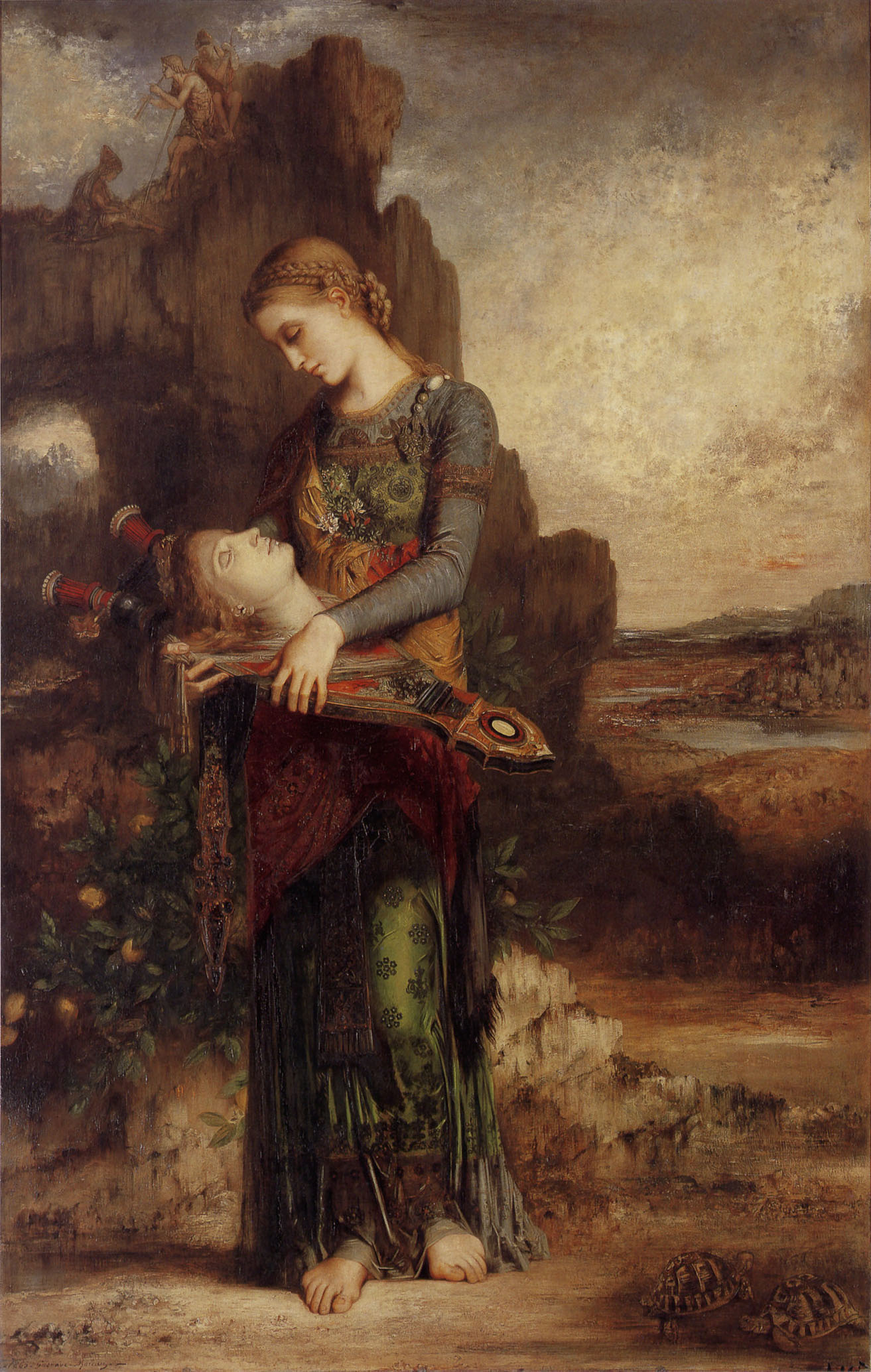

Thracian Girl Carrying the Head of Orpheus on His Lyre, Gustave Moreau, 1865

I thought it was interesting that the story's ending was changed into a happy one. I don't know why the ending was changed - my guess it was an attempt by the author to make the story more accessible to a newer, more modern audience? But several of the stories we've read were incredibly brutal and violent. What makes a husband losing his wife through his lack of willpower/emotional devastation and then being torn apart by drunk Dionysus groupies any different than a head getting chopped off or a poker up the ass? All of those things kind of exist in the same vein. There's no reason the author couldn't make it more like a traditional romance, unrealistic violence and all. 

This story was a change, because there wasn't really any violence or political intrigue. It wasn't quite... boring, but it also wasn't as bombastic as, say, the Knight of the Cart or the Knight's Tale. 

Not present in the story: rippling muscles.
Also not present: pretty much any action at all.

The one thing that irritated me about Sir Orfeo is that there isn't a reason given as to why Herodis is abducted. It just seems like the king of the underworld showed up in a dream and kind of told her he was gonna grab her for no good reason. Am I missing something? 

Overall, I really liked this story, if only because I enjoy the Orpheus legend and all its various forms, even Tennessee Williams' Orpheus Descending which follows the legend but... in a really abstract way? What even happened there? Anyway, Sir Orfeo is an interesting take on a very archetypal myth. 


All Those Trees, Man....

So I had to start this by admitting that I had no idea what a grafted tree was before I read this story (I most definitely do NOT have a green thumb) So naturally, I googled the definition, as well as a few pictures. Please enjoy the following for your viewing pleasure:


Once, that was clear I had to figure out why the hell this even matters.  (And it does.  I don’t know how, but I can just feel it.) From a spin off site of Wikipedia (I know, I know, but it was the quickest) I got the following definitions:

Noun[edit]
imp (plural imps)
1.   (obsolete) A young shoot of a plant, tree etc. [9th–17th c.]  [quotations ▼]
2.   (obsolete) A scion, offspring; a child. [15th–19th c.]  [quotations ▼]
3.   A young or inferior devil; a malevolent supernatural creature, similar to a demon but smaller and less powerful. [from 16th c.]  [quotations ▼]
4.   A mischievous child. [from 17th c.]  [quotations ▼]
5.   (UK, dialect, obsolete) Something added to, or united with, another, to lengthen it out or repair it, such as an addition to a beehive; a feather inserted in a broken wing of a bird; or a length of twisted hair in a fishing line.

I focused on the first two definitions the most, which apply most in this situation because their use is obsolete and it just so happens to be the one used in this story.  With these definitions, I’m afraid I didn’t find much help, because I had trouble finding connections.  Almost every time we see Herodis in the story, she’s under an “impe-tree.” Now, this is me just trying to find the significance in that. 

I included the hyperlinks in case you wanted to see for yourself, but what is most interesting is that not only is an “impe” a young, slightly modified form of a tree, it’s also a scion, which is considered a child, or more specifically, a descendent.  So this is really cool, because this story is just a Medieval account of the story of Orpheus.  So this leads me to think: is Herodis meant to be a descendent of Eurydice? 


The way the author of this story makes a Christian world connect to Greek mythology is actually really awesome.  I noticed a lot of tiny nuances that made this possible.  Such as the tree imagery.  (“’He is wrinkled as a tree!’” (510)). And when the story alludes to Adam and Eve:
            He who in ermine robes was clad
            And sheets of purple linen had
            Now lies upon the moss and clover,
            Leaves and grasses for his cover (240-244).

And later when it says, “Nothing to give him joy or pride, / But just the snakes that past him glide” (251-252). I could be way off base there, but it’s interesting how there are parallels, not only with that story, but also of the Christian way of humbling yourself  ( just as Orfeo does in this situation)

I did say I was disappointed with the ending, though, although I think I can recognize that the audience of the time needed this kind of ending.

No one actually gets a happy ending at the end of this myth.  Instead, Orpheus actually DOES get ripped to shreds, and his wife doesn’t get to live at all.  I wish the author would’ve found a way to modify the ending in such a way that it was the same outcome, but achieved in a different way. Just like the rest of the story modifies the original tale. I feel like they just got lazy at the end and decided everyone was going to be happy.

But then again, maybe the author recognized that his audience wouldn’t be satisfied with that kind of ending.  It’s got everything a medieval person wants to read: suffering over the loss of a love, honor, chivalry, music, a happy ending, and a Christian, moral lesson.  Orfeo needs to test the loyalty of his people.  The author of this story had to modify the story to adapt to a relevant lesson for the time. 

I get it, but I don’t necessarily like it. 


And here are the links to those definitions, in case you wanna check 'em out:

Impe:


and Scion:


Wednesday, April 1, 2015

The Knight's Tale..... A Greek Mythology and Medieval Twist

I’m not sure if I’m the only person who thinks this… but constantly when reading this story I visualized the scenery and a lot of the characters as the movie “A Knights Tale” Obviously the title is almost exactly the same, but overall the plot is pretty similar to throughout reading I pictured Arcite as Heath ledger… probably just because he is one of the main knights who is one of the top in fights and fierce battles.


 The biggest difference between the two is the movie doesn’t have the somewhat of a Greek mythology twist that I sensed a lot while reading. I feel like most if not most of the stories we have read so far contain religion and praying and relying on god in their journeys. But The knights tale was a little bit different. The addition of 3 temples to the gods, to protect him in battle showed in my opinion that their beliefs wasn’t that god or the gods could protect them or watch out for them, but more the gods had full power over them, which was a concept that I feel wasn’t really showed in some of our other stories. When the story talked of the temple of the gods I couldn’t get the image of Hercules in the temple of Zeus in the Disney movie when he was talking to his dad, a giant, moving, marble statue


I don’t know why but I was somewhat disappointed when Arcite died… I was kind of rooting for him throughout the story to win the battle and marry Emelye. I know the story pushed the thought of dying an honorable death is a great thing…. But in my opinion I could care less how someone dies. After he died Theseus gives his long speech of how everyone dies and dying in battle is honorable and somewhat of a great thing, I feel like I would much rather be alive and healthy than die a painful war related earth caused by battle wounds… even if it is considered honorable.

One thing that I thought was unique about The Knights Tale was how little gender related it was. Sure, a main concept of it was to win the love of a woman, and I guess that means she was no say over who she marries, but I feel like Emelye had a lot more power and in a sense of freedom than most of the other women in the other stories we have read. 

Tuesday, March 31, 2015

The knight's Tale...or is it the Gods' Tale?

Before I started reading The Knight's Tale, I wondered (and maybe and hoped a little) that the story would be like the movie A Knight's Tale with Heath Ledger. I'm going to be honest, I was kind of disappointed when it turned out to be completely different. I mean, come on, who wouldn't love a story about a guy "changing his stars" (as the movie puts it), and getting the girl of his dreams despite lying about who he is at first?!
Wink Heath Ledger animated GIF
Well, although the story we read for class is completely different, I suppose it was still a good story.
Heath Ledger A Knights Tale animated GIF
I was a little taken aback by the setting of this story in particular because I do not generally associate Ancient Greece with the medieval romance stories about kings, queens, and knights. I guess it still works though because they still had the aspects of courtly love and medieval romance in general in the story. They had the knights fighting for what they love...aka a beautiful woman that they do not even know, a king to guide them, and rules, of course.
http://mamre8history.wikispaces.com/file/view/fighting_knights.jpg/87480105/fighting_knights.jpg
I just want to take this opportunity to talk about how accommodating the gods/goddesses are...well kind of. They come to a compromise of sorts. Mars and Venus get what they want for Arcite and Palamon, while Diana has to tell Emelye that she has to marry one of the them (which she kind of said was okay if she could not get what she really wanted− to remain unmarried). So, thanks to Saturn, everyone sort of gets what they asked for.
https://s-media-cache-ak0.pinimg.com/originals/ab/68/cb/ab68cba8278a36bd741172d6e437cb8f.jpg
Overall, I think this story was interesting, but I feel bad for Emelye. Yeah I know she got her second choice, but she's really the only one losing in this situation.

Divine Intervention? More like Godly Playtime

As I was reading this, one thing that really stood out to me was the Gods’ interventions. There was only the one small part where one of them physically intervened (when they killed Arcite), but when I looked at it a second time, I saw that their responses actually foreshadowed the result of the battle.


                When Palamon visited the temple of Venus, he never got a definite answer that he was going to win the fight, but we later read that her father was going to do something to make sure that her champion wins Emelye. And what do you know, they were right! Palamon was never told that he would win so he lost the battle, but then Arcite was killed so he was the only one left to marry Emelye.
                Then there was Arcite. He went to Mars and prayed for victory in battle, but doesn’t even mention Emelye. So what does he get? He wins but doesn’t get the girl, exactly what was promised to him. Although, I have to admit that his whole section really annoyed me. The only reason he entered this fight is because he thought that he love/deserved Emelye more than Palamon. But when it came time to actually fight for her, he completely forgets about her! Is that what he calls love? Because it just seems like a bad case of possessiveness to me. He saw something pretty so he wanted it.
                And then there was Emelye. Oh man did this piss me off! She went to the temple of Diana to beg to keep her chastity and not have to marry one of them, but she was basically patted on the head and told “that’s nice”. I know they didn’t really care about what women thought about marriage at that time, but she literally begged! And no one cared! She was stuck doing what everyone else told her to do.


So yeah, needless to say: I didn’t like this part. All of their actions annoyed me (except for Palamon because he did actually do this for love), and the gods just messed with things for kicks and giggles.

Monday, March 30, 2015

Knightly Taste Aversion … Is There an End in Sight?

The first time I was introduced to Chaucer’s The Knight’s Tale (as I suspect is true for most) was in a high school English class. Even though I have fond, fond memories of the two days I spent watching Heath Ledger parade around a fictional medieval world with perfectly tousled hair and sexy, shiny armor… I can’t remember one interesting piece of information from our class’ actual discussion of the tale itself. The only thing I do remember (save for Heath’s lovely smile) is the lasting sour taste the story of Arcite and Palamon left behind in my mind.


The ‘taste aversion’ to The Knight’s Tale that I began to develop in high school (much to my dismay) only grew stronger over the following years as I subsequently encountered the text again and again. Try as I might to connect with the story, there was always some aspect of it that simply put me off. The most glaring example is of course the character of Emelye, who has basically no say (except for her ability to pray) or choice in the matters that directly affect her life. Although I understand that this is due to the social structure of the medieval world... it is still enraging as a modern female reader to encounter a story where the women are depicted as such. In all reality, this is probably the number one reason why I have such an aversion to the character of the Knight and to his tale (although there are many other reasons as well). Even though I do value the tale a great deal on the whole, the fact remains that I simply do not enjoy reading it. Or at least that was what I thought.

After being faced with the reality of having to read The Knight’s Tale yet again, I decided that, even though I had officially filed the story away into my ‘unpleasant reads’ folder (or to borrow a term from Sherlock and the ancient Greeks, my mind palace), I would try as much as possible to resurrect it and remain open to new insights. Although the tale isn’t my favorite choice, I was determined to find something about it that I had previously overlooked to like. Thankfully, I succeeded.


Although it may seem a bit dark, re-reading the tale and paying closer attention to the prayer’s of Emelye, Palamon and Arcite helped me to better understand (and take a bit of pleasure in) the latter’s death. In previous readings of the tale Arcite’s death puzzled me and I have never quite been able to resolve my feelings about it. Now however, I’m certain that I am able to derive a great deal of satisfaction from it. By praying to Mars and desiring victory in battle above all else (in an attempt to obtain Emelye, who he sees as having to be won by force) instead of putting his love for her first and praying to Venus like Palamon, Arcite looses both his life and his ‘love.’ Palamon on the other hand, eventually wins Emelye’s hand in marriage and even though my somewhat feminist heart is screaming that he is still undeserving of her, I feel much more contented after finishing this latest reading. At least Palamon put love before war. In my book this makes him the lesser of two evils.

Overall even though this tale my not be my personal cup of tea, I am certainly glad that there is a possible end in sight for my ‘taste aversion’ to it. In previous readings I considered Arcite and Palamon to be almost one in the same (perhaps the reason I was so puzzled by why Arcite had to die and not Palamon) but now that I have paid more attention to the subtle differences in their actions it is looking less and less like this is the case. Finding something new to enjoy during this reading of Chaucer’s tale has certainly given me hope for the future (although I don't think I'll be pulling this out of the 'unpleasant reads' folder anytime soon). 

What is Love? Nah.. More like an unfair fight!!

 
I have to admit that I like the fact that Greek Gods were involved. Seeing as I am kind of obsessed. But onto the story Theseus is either weird or willing to spend boatful’s of money on a tournament and three temples for the Gods: Venus, Mars and Diana. Then as the tournament gets closer the people all gather to watch the battle. Both of our knights, Palamon and Arcite return with their magnificent armies. The before the battle each person, Palamon, Arcite and Emelye go to one of the temples to ask for help. Palamon goes to the temple of Venus and tells her how much he desires to be with Emelye and asks Venus to help him win in the name of love. Venus sends him this mysterious sign and basically says, “I am on your side of this battle.”
            Then a few hours later Emelye goes to the temple of Diana and asks to remain a virgin and not have to marry either of them. Then Diana appears in front of her and tells her that she has to marry one of them. Then Emelye just goes back to her room and basically just accept the fact she has to marry someone who she doesn’t really know. I think that when a woman is getting married shouldn’t she be … don’t know somewhat excited to get married not indifferent. But you know that is just my opinion I think marriage should be about EQUAL LOVE on the side of both the man and the woman. Not that “Oh I have to marry you because Diana said so and because you’re the only one left alive.”
 
            Later that same day Arcite goes to the temple of Mars and begs the god of war for help winning the battle and he gets a sign as well and Mars whispers  “Victory!” which in my mind the way I envisioned it was a little eerie and creepy. Then we get to see the god’s point of view. Where Saturn, Venus’s dad tells her that Palamon will win even if Mars helps Arcite.
 
            Then comes the FEAST. Because you cannot have a battle without a gigantic feast.
 
 Then the battle starts and Theseus goes on about the rules of the battle and then the bloody massacre begins.
 
 
Palamon fights alright but in the end Arcite wins and everyone is happy especially Emelye when Theseus states that Arcite is the winner but because Venus starts crying and her daddy wants to fix everything he kills Arcite by making and earthquake appear and injure him. On his death bed he tells Emelye how much he loved her and that she should marry his cousin if she were to get married. Then after a time warp of mourning Palamon and Emelye get married and are eventually happy.