Monday, March 23, 2015

How do you say “The Wife of Bath’s Tale” in Middle English?

First off, why the Middle English? I mean come on! It was such a pain; I literally had to go back and forth between the two books just to make sure I understood everything…I know I know. I’m going to have to get used to it anyways. Interestingly enough, I tried to make the accent and sound like Dr. MB when she reading this…it didn't work out.

Now all that’s aside, onto the story. I actually enjoyed this story. I thought I could have referenced what I was reading to myself. Not the rape part! But about how much power the women held. First things first, why the rape? Knights are suppose to be honorable and loyal, not rapist. Out of all the acts he could have done, he rapes a random maiden that just so happen to be walking past him? This part of the story is what helps trigger the power of women.

So now, about his savor. Did you ever wonder why King Arthur willingly gave the queen the power to decide on what to do with this knight? This was pretty confusing and a turning point for me. The queen was nice enough to give the knight a second chance. All the women in the court, the queen included, wanted to give him another chance before he killed…but why? It was confusing to me why the queen would even want to spare his life in the first place. But! This is where the knight started to lose his power. He knew that he committed a crime, and in order to gain his position back, he must follow orders from a WOMEN. I loved this. She gave him a time limit that he must fulfill, and boy did he make sure he got back in time to give a proper answer.


This whole thing about him learning a lesson, I believe that he did. As a knight, he did keep his word with the old women. Even though he was stunned by her request, he had no choice but to marry her. He really looked down upon her because she was old and ugly, but was that really the case? The old woman goes on and on about the choices she offers her husband. I wish she had turned pretty and treated him differently just for him to get a taste of his own medicine! In the end, he was the one willingly giving up his power to his wife to make the decision for the marriage. He knew that by doing so, it is her that help saved his life. Isn't it ironic that he told the queen that what women desire the most is sovereignty and control over their husbands? Well! In this case, he fell right into it.

Ugly ducklings need love too!

Kneeghts and Fayerays: Every Middle (English) Man for Themselves

This story was a complete and total whirlwind. I've never read Middle English before, so I decided that it would be best to read the entire thing out loud and get a feel for the words. It is so very, very difficult not to say knight as nite instead of KNEECHT and might as MEECHT, but it was a learning experience, and was actually really enjoyable and hilarious.   


Im heer to ruine alle youre lives. 

That being said, I did like the story overall. I thought there was a bit of a change in the Wife's sermon now that we read it in the original text, that there was more emphasis placed on poverty than what the modern English version had given us. Maybe it's just because it's a different form of English, but I felt there was a lot more emphasis placed on the socioeconomic status of the wife. 

I also felt it was easier to disconnect from the kneecht and his crime, maybe because it takes a little longer to process the words, but...  I didn't see too much emphasis on character? I mean, there are Distinct People here who Do Things, but aside from the fact that the kneecht is a completely shitty person, there's not a lot of who they are. I couldn't really feel much personality from any of them, which is always strange for me in a piece of literature. 

(and now I'm going to forever refer to "knights" as "kneechts" and no one can stop me)

The Wife of Bath's Tale

I sort of really enjoyed reading The Wife of Bath’s Tale due to the rhyming.  Rhymes are simply universal, they’re always fun.  However, The Canterbury Tales version was less than enjoyable…  

This story revolves around the idea of power.  How much power should a person have and who should that person be?  Classic men verse women and too much verse too little.  The story begins with rape – a knight taking advantage of whatever power he has as a knight and using it against women.  At first I didn’t understand why all the women immediately came to his defense to help save his life.  But that’s when the tables turned in this story.  The knight went from having all of the power to having none.  The women were in charge, controlling whether he lived or died. I’m not sure if they even cared whether he died or not, as long as he felt the same powerlessness that he had done to the girl he had raped.  But is that really the best way to teach someone a lesson?  You hit someone, so they can hit you back?  You could argue that it is a little hypocritical. 

However, it ends exactly the way the women want it to, of course.  He “learns his lesson” by giving his wife all the power to make decisions, since after all, the thing women want most is power over their husbands.  But how is that fair?  These women have issues with men having all the power, but only because they want it all.  In reality, nobody should have all the power. 

The topics in this story, like sex and marriage and decision making should all be mutual.
I don’t think the knight has learned his lesson of the crime he committed.  I think he learned what he has to do in order to get what he wants.  As long as he gives his wife the power, she will give him what he wants. But then who really has the power?  And does it even matter if he has learned his lesson? Either way, he’s giving his wife control, which is what she wants.  And in return, she is giving him what he wants.  So technically, they should both be happy.  But logically, it makes no sense.  By the wife having all the power, it’s really the same as her having none since she is willing to do anything for him anyway.  Everyone in this story needs to realize that too much power in any situation is just bad. 

Happy Wife, Happy Life

          So the popular topic of conversation regarding this tale seems to be whether or not we think the knight learned his lesson in the end.  All I could think was well…he’s married now…isn’t that punishment enough? But all jokes aside, I can’t really say I was thinking about whether he learned his lesson or not by the time I finished the Wife of Bath’s tale.  I was strangely satisfied with the ending, actually.  Believe me that one definitely came as a surprise. 

          
          Actually, I kept referencing the Wife of Bath’s prologue instead.  The narrator of this story is the Wife herself, and she’s—for lack of a better term—a badass.  Many people think of her as an early feminist. (Not the man-hating type, but the real ones who take charge of their lives and do what they want.) The Wife loves men, actually, because she’s been married umpteen times.  At the end of her prologue her husband basically beats her up and she reciprocates with just as much force. She’s all like “always do what I say and we won’t have a problem again.” I can respect that…happy wife, happy life, eh?


          So with that in mind, I resolve to say that he did learn his lesson, in a way.  Now, I’m not condoning rape…but think about this: How many men actually find a definitive answer for what women want? And in a way this is totally true we want to have power over our men, or at least be equal with them.  And I kind of give him credit for being able to look past his wife’s ugliness long enough to consider that trusting her would be a good idea.  He puts all his power in her hands, and to quote the English version, he says, “You choose, for pleasing you now pleases me” (1235).  In that moment, he sacrifices all his power to her.  In the end, she was right all along, and he realizes that by the end of this story. Rather than just believe it because he wants to save his own life, he sees that what she says is true.  And I personally give him props for looking past her ugliness for two seconds she could show him the truth.  Can we say the same for some of the other men we've read about in these medieval stories? Relatively speaking, they kind of get a happy ending. 


          This story isn’t just about learning to respect women.  It’s also about learning to find humility and respect people in general.  Yeah, it’s about women gaining power (because the Wife is the ultimate symbol of power herself) but it’s also a great story to show how people deserve redemption and forgiveness. This knight lives because he serves as an example. He does a complete 180 by the end of this story.  Shouldn’t he get credit for that?  I think a happy ending is nice once in a while. 


Sunday, March 22, 2015

He gets what now?

As I finished The Wife of Bath's Tale, I immediately had to re-read it. Even translated into modern day english I found I had to double back to understand what had taken place. Now, I will admit I'm still working through the middle english version...that's some rough language.
I can't believe that the knight, who completely disregarded his knightly code of honor and committed such a disgusting act, still got "redemption". Not to mention his wife went all Hocus Pocus and suddenly the ugly crusty woman he forced himself to marry is now beautiful and everything is peachy. Yeah, he really learned his lesson.
http://media.tumblr.com/9aa5f27a77d83bf4d45c63fd6796312f/tumblr_inline_nadiiiaha61sj0gb9.gif

This knight, someone who is supposed to be widely respected and trusted, violated a girl in the worst way possible. But it's okay cause the fairy queen-lady-thing gave him a good talking-to so he totally learned what he did was a no-no. Seriously? Even if the queen decided to send him on this impossible task(seemingly impossible at the time) I would still argue she should have let the guy die. Forever.
http://i.kinja-img.com/gawker-media/image/upload/s--7VTWhR1E--/oe8fiivtffbjbusulc8z.gif

Another issue I had with this particular little tale is when the hag told the knight her ugliness should be a security to him. “Don’t worry, the fact I’m ugly means I’m less likely to cheat on you.” Are we really going there right now? Did I really just read that? How about the knight made a promise to do whatever you want, a situation he got himself into in the first place, and whether or not he likes you he should honor that promise. OH WAIT! He raped a girl so I can see how she would worry he might cheat, but never ever should a girl think of herself like that. Even if she is a fairy queen who totally and completely knows what she is doing by manipulating the entire story, it still infuriated me.
https://33.media.tumblr.com/fe69a267bad77c9ff17a79a938e53718/tumblr_n93rfq1CU31tfo43go2_500.gif

So, do I think he really learned his lesson after the really long sermon? Not really. I’m curious if anyone did. Even still, should the hag have transformed herself into a younger woman in despite of his crime? Maybe. I don’t believe he deserved it, he violated everything knights stand for: chivalry, honor, respect. He ignored all of them just to satisfy himself. I wonder what people thought of this story when it was written...would they agree or disagree with what we are saying now?
http://33.media.tumblr.com/79a04632fcaf5ee23fe6bcb52c93d6b3/tumblr_n4cknktFAS1tr2c16o1_500.gif


Wednesday, March 18, 2015

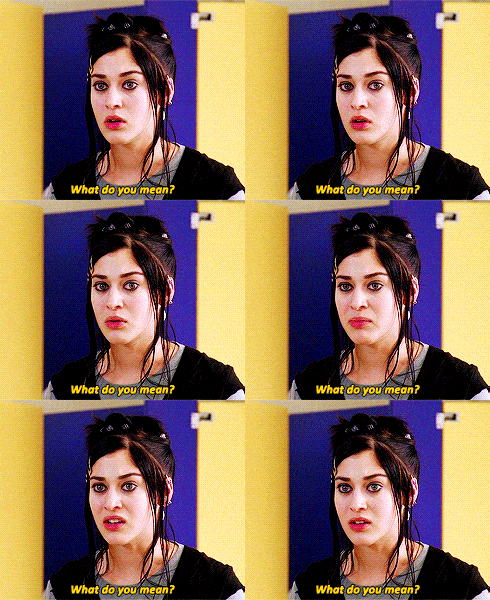
Who knew Mean Girls, Britney and the Wife of Bath could relate somehow?


We have started reading the “Wife of Bath’s Prologue and Tale” by Geoffrey Chaucer and I have to say that it is a doozey. I have actually read this story twice before, once with Dr. MB and another time in high school. Luckily, because of this, the Middle English did not scare me as much as it did the first time. But a word to the wise- the notes and translations on the side of the page help immensely! But anyways, back to the Wife of Bath. What is everyone’s opinion of her? I confess that my opinion of her has changed after having read the story several times now. My first impression was to thrust the story aside because the ease with which the Wife flouted her escapades and manipulations over the men in her life made me sick. However, I have begun to wonder if she was not just a product of her time period? Like we have been saying in class, women had little to no power in medieval times. Maybe the Wife of Bath’s prologue and her life’s accomplishments are just an over exaggeration of what she really wants in life- power. The Wife has had five husbands- not too farfetched a fate in this day and age to be honest. She said that she has had three good husbands and two bad. (197) What I found most saddening about this prologue was the story about the one husband that she married for love. His name was Janekyn and he was her fifth husband (303). How cruel it must be, (though she was twice his age) to love someone and marry them for love and then to find that love to be imperfect.
Britney Spears Crying animated GIF
 
But I digress, there is so much to say about the Wife’s actual tale, and I still cannot tell you whether I like it or not. I suppose I am relieved that the knight in question actually learned that what women want most is a choice, a chance for equality. However, do I believe he deserved redemption for his crimes in the beginning of the story?
 
Confusion Dyed Hair animated GIF
 
Absolutely not. I really just do not believe that he, at the end of the story, deserved to have a wife that was both beautiful and good. I mean…he raped a young maiden for the love of Pete! Perhaps some of my group members could share their opinions on this? Does this knight deserve his rewards at the end of the story? OR am I missing the point completely…maybe it is about the woman? Maybe she chooses to be beautiful and good, not for him, but for herself?


Monday, March 2, 2015

Medieval Philadelphia

            If I read this story right, I believe it serves as a companion story to “The Knight of the Cart”. Both stories talk about love in two entirely different ways.  While Lancelot and Guinevere show the major follies of acts of love, I think Yvain presents the very noble aspect of the virtue.  Of course, this must include a lady in which Yvain falls deeply in love with…duh…but I’m way more interested in the almost brotherly love portrayed in this story. 
     First, with the lion.  The lion is so devoted to his master, he almost kills himself out of grief when he thinks his master is dead.  “Never have I heard told or described such grief, “the narrator says (298).  It also says he “threw himself about, clawing himself and screaming” (298). This is not unlike the lady at the beginning of the story whose lord was killed by Yvain.  So the story also shows the importance of grief.  It humbles you, makes you human.  And I think that’s why I grew to like that lion so much.  And the people did too, after they saw his devotion to his master.  I gotta admit, though, I was scared he wouldn’t make it. And honestly, I would’ve been pissed.  But I think the best portrayal of this is when Yvain tells King Arthur’s people not to be afraid of him:  “Do not fear or harm the lion you see approaching, “ he says, “Please believe me. He is mine and I am his” (334).  It’s only an animal and the story makes me love him just as much.


Next, the whole fight with Sir Gawain pulled at my heart strings.  Of course the readers know who each of the knights is, but they certainly don’t (I won’t even address how stupid that notion is). So the whole time, they’re fighting each other and I’m just like NOOOOOO he’s your companion too! Anyway, one of the most palpable parts of this story is when Chrétien personifies Love and Hate.  Just like in “The Knight of the Cart,” Love is a character.  But here, I don’t think it’s used as an excuse for an act, but rather I think we’re meant to  see love in an optimistic light—one that stops hate.  “Now Hate is ready for the forward attack, spurring and pricking against Love whenever he can, and Love does not even stir” (329). I find that absolutely beautiful.  When they recognize each other and cease fighting, King Arthur says, 
there is great love between you and prove this when each declares his own defeat” (333).
I think that Yvain represents everything Lancelot doesn’t.  He’s noble, not a hypocrite, and does everything—successfully—to nobly gain his woman back.  These two stories coupled together teach us parallel lessons about love and nobility, just in different ways.

            And all of this started because Kay had to be a dick.